Showing posts with label U.S. Constitution. Show all posts

17 June 2022

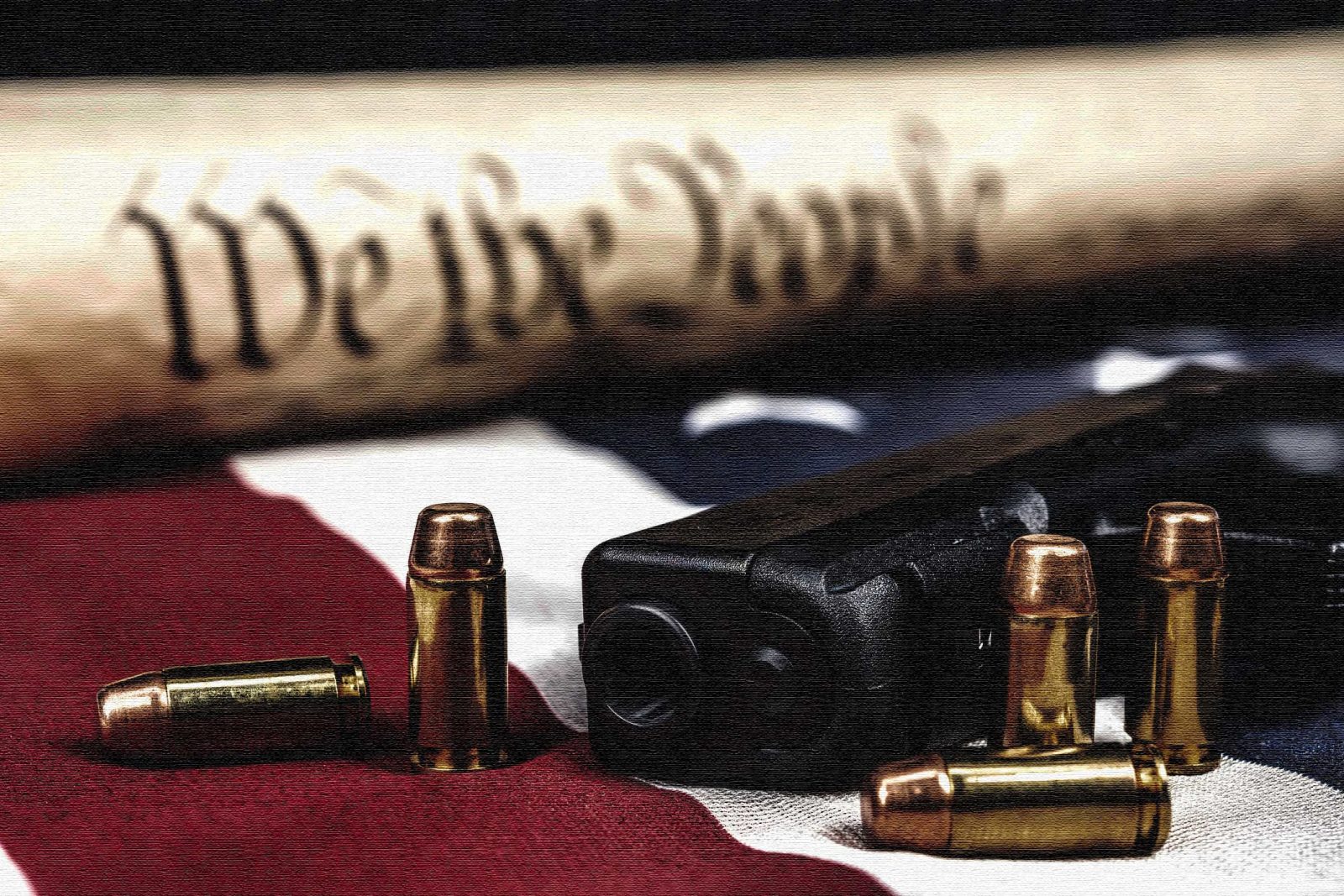
The fake ‘common sense’ of federal gun control laws

By AlaskaWatchman.com

“A well regulated militia being necessary to the security of a free state, the right of the people to keep and bear arms shall not be infringed.”

Having organized large gun-rights rallies in the past, completely unaffiliated with the NRA, I have sometimes enjoyed playing a little game with the faithfully assembled pro-gun crowd.

“OK, everyone, where do we get our right to keep and bear arms?”

With few exceptions, the joyous reply came back, “The Second Amendment!”

My reply was “No, no, no, and furthermore … no. The Second Amendment is better than that!”

All of the first ten amendments (the so-called and misnamed “Bill of Rights”) merely state that federal interference with these singularly identified rights would never be permitted. But since they have been permitted, we have a big, fat problem on our hands. But why should we be surprised? The federal government has violated these amendments since George Washington, influenced by Alexander Hamilton, signed into law the Bank of the United States, violating the 10th Amendment.

The federal Constitution does not grant to the states the right to organize and regulate a militia, because they are sovereign and do not need such permission.

The Second Amendment does not give us any rights … thank God. If it did, then we would be accepting the very dangerous premise, to wit: “The government giveth, and the government taketh away.” Instead, it recognizes a pre-existing right, given to us by the Natural Law of God – the law of self-defense.

Liberals always try to equate the 2nd Amendment somehow with a collective right, since it mentions militia, but they overlook a few details. Imagine that.

First of all, the term “militia” also encompasses the two variances, “organized” and “unorganized.” The unorganized militia is the entire citizenry, ages 17-45. Note that the amendment begins with, “A well-regulated militia being necessary to the security of a free state.”

Regulated, in this case, means “well trained,” not “controlled by the federal government.”

The federal Constitution does not grant to the states the right to organize and regulate a militia, because they are sovereign and do not need such permission. It does, however, state that under times of invasion, they may be incorporated into a national defense. So far, no sweat.
Liberal states are trying to use their overt power in the federal government to force-feed down the throat of Alaska and other pro-gun states their own leftist gun policies.
But what about this comment of “… being necessary to the security of a free state …”? Liberals, if they understood history and words the proper way, would stop wielding this portion of the amendment as a bludgeon for gun control. Ladies and gentlemen, the militia exists as a warning and threat to the federal government, to prevent the temptation of aggrandizing increased power through force by a national and dictatorial army.

It was not intended to reference a foreign invader, which is abundantly covered in other portions of the Constitution. This means, then, that state resistance to federal tyranny was a recognized right. This is very, very hard to swallow for mainstream historians. They believe that the misnamed “Civil War,” was fought to save the union and eventually to free slaves. Instead, it was an utterly unconstitutional violation of the entire premise that these united States created a voluntary federal union (the lack of capitalization is used properly here).

The slavery crisis was actually fed by the pro-union sentiments that created the Constitution. In order to bring to birth a continental empire with unlimited potential for wealth and power, slave interests in the South had to be guaranteed their property in human bondage, or else they would have opted for complete independence. Thus, business and empire held sway over human conscience. In this sense, the U.S. Constitution violated Natural Law right from the start by protecting slavery. It could only fester into something worse every time compromises contributed to the the injustice, largely for the sake of fulfilling the temptation of a coast-to-coast empire.
To cut to the chase, there is no such thing as “common sense” and “reasonable” federal gun control laws. Every one is completely unconstitutional.
Secession was not a southern invention, but originated in New England in the late 1790s and early 1800s. Why? Because new states, west of the Appalachians, threatened their congressional power. This was confirmed soon afterwards by the ill-fated War of 1812, which destroyed New England’s economic livelihood. Many was the time when northern abolitionists agitated for secession from the slave power, including former president J. Quincy Adams, who as late as 1845 thought that the entry of Texas into the union would justify New England’s departure.

And aside from the fact that the 10th Amendment implies the legality of secession, and aside from the fact that Virginia, New York and Rhode Island approved the federal Constitution on the condition of withdrawal should their liberties ever be threatened, and aside from the fact that not a single state objected to those conditions because they themselves accepted the same idea, it can be said that the Second Amendment also implies this right.

This makes not only Abe Lincoln but Andrew Jackson dictators and tyrants. Either that or Thomas Jefferson was a traitor. It’s one or the other. In his First Inaugural in 1801, Jefferson promised not to interfere with New England’s threat to secede. And toss in J. Quincy Adams, too.


Imagine: both Lincoln and Jefferson thought that their Oath of Office to “preserve, protect and defend the Constitution” required completely opposite conclusions!

To cut to the chase, there is no such thing as “common sense” and “reasonable” federal gun control laws. Every one is completely unconstitutional.

Now, that does not mean that a state cannot decide to exercise gun restrictions. We would not dictate to New York, California or other liberal states what they want to do. And Alaskans already have done quite the opposite with recent state constitutional amendments and concealed-carry statutes.

Liberal states are trying to use their overt power in the federal government to force-feed down the throat of Alaska and other pro-gun states their own leftist gun policies. The time to resist is now. Gov. Dunleavy needs to be reminded of the Firearms Freedom Act of 2013, and legislators need to put new teeth into the law, as it was originally drafted: arrest federal agents that try to enforce unconstitutional gun control laws.

The views expressed here are those of the author.


Bob Bird
Bob Bird ran for U.S. Senate in 1990 and 2008. He is a past president of Alaska Right to Life, a 45-year Alaska resident and a retired public school teacher. He has a passion for studying and teaching Alaska and U.S. constitutional history. He lives on the Kenai Peninsula and is currently a daily radio talk-show host for The Talk of the Kenai, on KSRM 920 AM from 3-5 pm and heard online radiokenai.com.

15 December 2015

"Being Necessary ..."


"BEING NECESSARY ...

By L. Neil Smith

Exclusive to Jews for the Preservation of Firearms Ownership

© Copyright JPFO. Inc 2012

A well-regulated militia being necessary to the security of a free state, the right of the people to keep and bear arms shall not be infringed.
-- United States Constitution, Amendment II


It's likely that no sentence has ever received as much scrutiny as the twenty-seven words of the Second Amendment, one of the first ten amendments to the United States Constitution, collectively known as the Bill of Rights and, as such, representing the highest law of the land.

A sophisticated understanding of the Bill of Rights informs us that it has been seriously misnamed over the centuries. It is not, in fact, a laundry-list of the things that citizens under its authority are allowed to do. Quite the opposite, it is a list of things that the government may never do. The document isn't about us, it's about all of those whom we have put in office or who have been put in office for us.

As "men of the left", including the President, have demonstrated they are fully aware, all of the rights identified by British and American political philosophers during the period leading up to the Revolution are negative in character, items (like search and seizure without due process) that should never be a part of an individual's life.

The Declaration of Independence acknowledges "certain inalienable rights"; the Bill of Rights treats them as having previously existed, and -- unique in the king-infested world of the late 18th century -- offers those pre-existing rights legal protection. Contrary to the maunderings of the trendy left, the Bill of Rights does not create, establish, or dispense rights of any kind to anybody. Nor was it meant to.

Those who favor an unalienable individual, civil, Constitutional, and human right to own and carry weapons tend to focus on the latter half of the Second Amendment, after the comma in Thomas Jefferson's draft: "the right of the people to keep and bear arms shall not be infringed."

Those who, for one reason or another, would rather see the entire populace disarmed, tend to be more interested in the first four words, beginning and ending with "A well-regulated militia ... " arguing that here in black and white (or brown iron-gall ink on yellowed sheep-skin parchment), the Constitution establishes weapons-bearing as a purely collective right, meant only to protect the government, and completely unnecessary, now that there's a National Guard -- not to mention a powerful standing army the Founders hated and feared the very thought of.

Thus the battle has raged for more than a century, and in only rare instances has the phrase " ... being necessary to the security of a free state ... " been given more than passing consideration, except by those intent on trying to collectivize an individual right. And yet it holds the key to understanding what the Founding Fathers had in mind.

"Well-regulated" in the 18th century, meant properly supplied and trained, and nothing else -- especially not "perpetually in peril of having their guns taken away". Yet to the anti-arms crowd, who believe that the government is the store and source of all rights, it means gun owners must be constantly harried, mocked, threatened, and spied on. Their impulse, given sufficient excuse -- Hurricane Katrina, for example -- is to seize privately-owned weapons from their owners. After all, you can't have folks being armed in an emergency. Who knows what they might do, up to and including surviving without government help?

The trouble with their position -- as well as with the tens of thousands of statutes, ordinances, laws, executive orders, and regulations they have written to support it -- is that it is flatly illegal, within several meanings of the term. Doubt me? Then, as President Lyndon Baines Johnson used to say, "Come, let us reason together ... "

According to the Second Amendment, a "well-regulated militia" is "necessary to the security of a free state". The Amendment makes it equally clear that "the right of the people to keep and bear arms" is necessary to raising a militia, universally understood in those days as everyday people who would remain unorganized until called upon to fight. Being prepared for that call meant owning knowing how to use firearms.

In other words, it is impossible to maintain a free state without a militia, and it is impossible to maintain a militia if the people's basic right to own and carry weapons is infringed -- to this day, a word specifically meaning interfered with even slightly, or in tiny increments.

As I said, in the 18th century, "well-regulated" meant properly supplied and trained. The word "regulate" carried absolutely none of the connotations of government control that it does today; the new meaning is strictly a product of Progressive Era politics, roughly 1875-1920.

The Founders were desperately afraid of the government acquiring a standing army, so they couldn't have been thinking of the National Guard in writing the Second Amendment, as is often claimed, or of anything remotely like it. Very likely they would have regarded the vast numbers of police employed across America today as a standing army.

In the same way, whenever they spoke of a militia, the Founders were speaking of "everybody" -- in those days, meaning every free male -- who could lift and aim a rifle and fire it. Later advances in civil rights eventually qualified women and individuals of color for the militia.

The Founders' thinking in this area was prophetic. Today (with the remarkable exception of the growing ranks of those who call themselves "Oath Keepers") our military and police are mostly controlled by the enemies of liberty. The survival of freedom depends on the unorganized militia who scared the pants off the enemies of liberty in 2009 when they showed up in the streets as the Tea Parties. The petitions of secession being signed now by hundreds of thousands across the nation must feel, to those who hate, loathe, and despise freedom, like an LSD flashback.

I am not a lawyer, nor do I play one on TV. But the Founders didn't write our nation's basic documents to be interpreted -- or interpreted away -- by lawyers. Not did they mean for judges to busy themselves the way they do today, telling us that our rights aren't quite what we have always believed them to be. Thomas Jefferson, especially, author of the Declaration of Independence , wrote in very clear, plain, beautiful English that doesn't call for interpretation. And so did James Madison, who wrote the Bill of Rights in order to placate and appease his friend Jefferson, who was deeply suspicious of the strong central government that the Constitution called into being.

All of which means that my plain English understanding of the Constitution, of the Bill of Rights, and of the Second Amendment, and very likely yours, as well, is just as respectable -- if not actually more so -- than that of any lawyer or judge, specialized individuals whose professional education invariably seems to distort their very perception of reality. And what I read in the Second Amendment is this:

If, indeed, the individual right to own and carry weapons is defined as being necessary to the security of a free state, then advocating, introducing, sponsoring, voting for, or enforcing victim disarmament -- gun control -- laws are all traitorous acts. Thanks to the First Amendment, private citizens are free to say anything they wish, but government officials, elected or not, have taken an oath to uphold and defend the Constitution against "all enemies, foreign and domestic."

Any list of the many foreign enemies of the Constitution would have to include the United Nations among its first and foremost. The U.N. has even had the temerity, recently, to order the President to punish the states of Washington and Colorado for having taken steps to legalize the production, sales, and use of recreational marijuana. The U.N. wants those votes somehow reversed, presumably by executive decree. That should give anybody a good idea of how the U.N. would act if it were given more power. Once a country signs on to its "Universal Declaration of Human Rights", it becomes illegal within that country to criticize either the document or the organization that generated it.

For its own part, the current U.S. Presidential administration is deeply involved in what amounts to a treasonous conspiracy with that despicable organization -- long a self-declared and outspoken enemy of everything that once made America the most wonderful place to live in the history of humanity -- to violate and void the Bill of Rights, through a "small arms treaty" that would give the U.N. control over the production, sales, ownership, and use of personal weapons in America.

Because such an agreement clearly endangers the security of a free state, the activities of the President and his hirelings, particularly the Secretary of State, are treasonous. Treason, of course, is fully prosecutable.

And there are traditional punishments for treason ...

~~~~~~~~~~~~~~~~~~~~~~~~~~~~~~~~~~

JPFO has quite an extensive index page on Bill of Rights matters which you can check out here. Much reference and interest.
A fifty-year veteran of the libertarian movement, L. Neil Smith is the Author of 33 books including The Probability Broach, Ceres, Sweeter Than Wine, And Down With Power: libertarian Policy In A Time Of Crisis. He is also the Publisher of The Libertarian Enterprise, now in its 17th year online.

27 March 2015

What Is The Constitution?

(A re-post, by request.)

by Orrin Hatch

On this day, [228] years ago, 12 state delegations approved the new Constitution of the United States and 39 of the 42 convention delegates signed it. They sent it to the states for ratification, the act that would make it the supreme law of the land. It is worth focusing on just what the Constitution actually is.

The Constitution opens by saying: “We the people . . . do ordain and establish this Constitution.” Nearly all Americans say the Constitution is very important to them and it requires that virtually all legislative, executive, and judicial officers, both state and federal, “shall be bound by oath or affirmation, to support this Constitution.” But what is this thing called the Constitution that the people established, that Americans say is so important, and that public officials swear to support?

The Constitution is the oldest written charter of government in use in the world today. Anyone who can read knows what the Constitution says. But words alone are just inkblots, and ordaining and establishing the Constitution was much more than simply putting some words on a page. Constitution Day would hardly be worth the name if it celebrated nothing more than a collection of words with no meaning. The Constitution we recognize today is more than an empty shell, it is more than what it says. The Constitution is what it means.

Think about judicial review, perhaps the most powerful thing that federal judges do in our system of self-government. In an appropriate case, judges must determine whether a statute is consistent with the Constitution. If they conflict, the Constitution wins. As Alexander Hamilton put it in The Federalist No.78, it is the duty of judges “to declare all acts contrary to the manifest tenor of the Constitution void.” But here we are back to the same question — what is “the Constitution” that judges use to conduct judicial review? What is “the Constitution” to which statutes must yield?

Charles Evans Hughes, who would later become Chief Justice of the Supreme Court, famously said about a century ago that the Constitution is “what the judges say it is.” Since judges cannot change the words of the Constitution, Hughes was really saying what today seems to be widely accepted, that the Constitution means whatever judges say it means. But if Hughes was right, then judges in effect become the Constitution and judicial review means that statutes must yield to judges.

But Hughes was wrong. The Constitution does not mean, it cannot mean, whatever judges say it means. If it does, then Hamilton’s reference to its “manifest tenor” makes no sense. A century before Hughes, Chief Justice John Marshall offered the opposite view in Marbury v. Madison, the case often credited with establishing judicial review. Marshall wrote that we have a written Constitution so that the limits on government power “may not be mistaken, or forgotten” and that the Constitution is “a rule for the government of courts, as well as of the legislature.” Judges are part of the government. If the Constitution means whatever government says it means, then government determines the limits on its own power. That would render the Constitution impotent and hardly worth the effort expended at the Constitutional Convention.

Marshall wrote that the Constitution represents “the intention of the people.” Intention is expressed through the meaning, not merely the form, of words. The Constitution cannot be the intention of the people if all the people did was choose some words without meaning. The Constitution could not continue to be the intention of the people if its meaning could be changed by anyone but the people. Quoting George Washington, the Rhode Island Constitution declares that “the constitution which at any time exists, till changed by an explicit and authentic act of the whole people, is sacredly obligatory upon all.” Empty words oblige no one. To be the Constitution, it must not only say what they said but it must mean what they meant.

The Constitution – its words and their meaning – was established by the people, can only be changed by the people, and is sacredly obligatory upon all of government, including judges. This is why the debate over judicial selection is really a debate over judicial power. It is a debate over whether the Constitution controls judges or judges control the Constitution, over what the Constitution really is, with nothing less than liberty itself at stake.

— Sen. Orrin G. Hatch is a former chairman of both the Senate Judiciary Committee and its Subcommittee on the Constitution.

19 February 2015

Quote of the Month


"The teachings of the Bible are so interwoven and entwined with our whole civic and social life that it would be literally impossible for us to figure to ourselves what life would be if these teachings were removed."

~ Theodore Roosevelt


Sadly, this is no longer true. We can now see precisely what life is turning into, as the Bible and the Constitution are actively being ignored.

06 February 2015

Still Windy

Strong winds have been blowing through most of southeast and southcentral Alaska since yesterday evening.


The highest gusts, according to National Weather Service meteorologist Julia Ruthford:

-- Eldred Rock northwest of Juneau was gusting at 114 mph early Friday morning. As of 7 a.m. Friday morning, gusts continued to top 100 mph.

-- In Thompson Pass north of Valdez, 96 mph winds were recorded at 10:21 p.m. Thursday.

-- At the Palmer Municipal Airport, 75 mph gusts were recorded at 9 p.m. Thursday.

-- At the Ted Stevens Anchorage International Airport in Anchorage, gusts of 48 mph were recorded at 7 p.m.


High winds Thursday sheared off a section of metal roofing at an apartment building on South Cobb Street in Palmer. The winds continued overnight into Friday morning in Southeast and Southcentral Alaska, with wind-related power outages and gusts as high as 114 mph recorded. Zaz Hollander / Alaska Dispatch News


The winds were out of the northwest at 30 to 40 mph this morning as I drove to work. The AccuHunch forecasters predict "North to northeast wind 15 to 30 mph with gusts 40 to 50 mph...strongest near Knik Arm and west Anchorage."

* * * * *

Speaking of windy (/snark), at least one economist is complaining that Governor Walker's announced budget cuts, project cancellations and layoffs of about 330 State employees will address only one-fifth of the shortfall.

The rest of us are waiting for the other boot to drop.

* * * * *

And after all the dire national and international news, you might wash your ears out with this: the Associated Press reports "Alaska lawmakers are considering a bill that would require school districts to teach American constitutionalism, the latest of several state government measures across the U.S. aimed at civics education."

07 October 2014

It Can't Contradict Itself

I just swung by the local post office, trying to find a correctly-sized shipping box, and I noticed once again the signs prohibiting firearms and other deadly weapons on USPS property.

This, next to a dozen or so good ol' Alaskan boys with an assortment of Leatherman pouches and Buck knives. No weapons? Yeah, right. Try to find an Alaskan without a knife; I'll wait.


But as an intellectual exercise, I wonder:

a) since the General Government* is a creation of the States and the Constitution they adopted, it follows that the G.G. cannot exceed its own Constitutionally-established authority; and

b) said Constitution states that the people have a pre-existent right to keep and bear arms, and prohibits Congress from making any law which infringes upon that right; and

c) any entity created by a contract has only the powers which the signers codified in writing therein; so therefore,

The USPS prohibition against firearms is prima facie unconstitutional. The federal judge who likewise ruled, a few months back, that the G.G. has the right to declare some of its land off-limits to firearms was wrong, too. Or, to put it another way, a federal entity must not restrict a federally-protected right on federal property - it's a contradiction to do so; it's the one place where those rights should be the most zealously guarded.

I do understand the concept of creating a weapons-free zone around a VIP, such as the President; it makes sense to establish a safe perimeter. But that's not tied to the land ... it moves with the person.

That being said, it's the law of the land whether Constitutional or no. I won't violate it, because incurring the wrath of the G.G. is definitely not a good idea, when it can be avoided.

But it is another aggravation; there seem to be an awful lot of them these days.


*Thomas Jefferson's preferred title for it; who am I to second-guess him?

18 April 2014

Friday Round-Up

End of the week (woohoo!); time to gather any loose threads and tie 'em up. I can only think of one ongoing story I've mentioned recently, though.


In a preliminary report released Thursday, the National Transportation Safety Board said the fatal April 8 plane crash near Bethel was preceded by several altitude changes before a "rapid, steep descent" to the ground.

Investigators say data transmitted by the Cessna 208 Caravan, operated by Hageland Aviation, shows the plane was flying at 3,400 feet when its altitude changed.
 (img1)New Document
"There were a couple of altitude deviations, followed by a rapid, steep descent," said NTSB spokesman Clint Johnson.

The two pilots on board were killed in the crash -- Derrick Cedars, 42, and Greggory McGee, 46. Officials said that Cedars and McGee were Hageland Aviation employees on a training flight. 
 They also said the flight went down 30 minutes after takeoff, in clear, calm weather. Curiouser and curiouser.

* * * * *
In happier news, we've been having quite a bit of sunshine, along with temps mostly in the upper 40s to around 50, and the remaining snow banks are melting quickly. Buds on the trees have trebled in size, and I think I heard geese honking last night.

Who knows? The grass will turn green one of these days, and then we'll get some leaves on the trees.

* * * * *
And finally, there's this:


28 January 2014

Quote of the Day

"Since the ratification of the 14th Amendment, the natural rights protected in the Bill of Rights generally have been insulated from interference by the states, as well. 

"All natural rights are of paramount importance to all persons. They are individualized personal gifts from the Creator and have been recognized as such in American law since Thomas Jefferson wrote in the Declaration of Independence that we are endowed with them by Him. 

"One of those rights guarantees the free exercise of religion. 

"Indeed, the Free Exercise Clause in the First Amendment was written to ensure that the new government could not coerce persons to behave differently than their religious views informed their consciences, or to punish them for not conforming to a government-mandated religious orthodoxy."

~ Judge Andrew Napolitano, from an editorial in the Washington Times

19 January 2013

The Bill of Rights is Not Negotiable

There's an excellent essay on the Bill of Rights at alaskaslist.com. Here's an excerpt:

The Bill of Rights is Not Negotiable
by Mike Adams

There is a destructive, delusional meme spreading like a virus among many misguided Americans. It pushes the idea that government can pick and choose which rights codified in the Bill of Rights it wishes to recognize or discard on any given day.

This delusion is predicated on the concept that if a popular majority can be emotionally whipped into a frenzy over one particular right, then that right can simply be discarded and stricken from the Bill of Rights.

But no such power exists to discard any portion of the Bill of Rights, at least not without proper ratification by three-fourths of the fifty states. There is no such power found solely in the federal government. There is no such power placed solely in the executive branch, nor in Congress, nor in the White House.

Go here to read the whole thing.

18 January 2013

JPFO Article: "The Right to Shoot Tyrants"

From our friends at Jews for the Preservation of Firearms Ownership (JPFO):

Another article from Judge Andrew Napolitano -- looking at the true meaning of the Second Amendment and explaining that the right of the people to keep and bear arms is an extension of the natural right to self-defense and a hallmark of personal sovereignty. Each human being is sovereign, as the colonists were after the Revolution.

"The historical reality of the Second Amendment's protection of the right to keep and bear arms is not that it protects the right to shoot deer. It protects the right to shoot tyrants, and it protects the right to shoot at them effectively, with the same instruments they would use upon us." Another of the Judge's pieces well worth sharing, which can be found here.

It's always disgusting to see how the Progressives have deliberately changed the meaning of the very plainly-written U.S. Constitution. It appears that my generation was about the last to study the actual words of that document, and see how it protects the citizens & the sovereign States. 

Strange how so few are talking about that, until recently. I'm greatly encouraged to see that it's rapidly becoming the topic now. 

'Bout time.

17 September 2012

Happy Constitution Day

Today marks the  225th anniversary of the signing of the Constitution of the United States, the greatest man-made document ever written to protect people from the tyranny of their own government.

Betcha didn't hear that on the local news. 


20 August 2011

Quote for the Weekend

"We don't need no stinkin' permission to exercise our rights. We need to exercise our rights whether they, the government, want us to or not!"
~ Michael Boldin, Tenth Amendment Center

27 June 2011

The Bill of Rights at 220

On December 15, 1791, Virginia became the 11th state to ratify the first 10 amendments to the U.S. Constitution.

On the 200th anniversary of that date, the Missouri Bar Advisory Board on Citizenship Education published "The Bill of Rights - An Introduction." My dad had a photocopy of that document among his things, and it was one of the very few items I picked from among them, while in Missouri last month for his funeral.

I quote from the publication:

"The Impact of the Bill of Rights

"The first eight amendments limit the power of government by specifying a list of rights and liberties [belonging to the people - Ed.]. The Ninth Amendment suggests that rights other than those listed may also exist. The Tenth Amendment underlines the fact that the national government exercises only powers granted to it under the Constitution. (1)

"Today, because of the Fourteenth Amendment of 1868, most provisions of the Bill of Rights also limit state and local governments. The Bill of Rights cannot lawfully be violated by the government unless the Constitution of the United States is amended. (2) Ordinary laws, therefore, can not amend the Bill of Rights. ..

~ snip ~

"Rights and Duties

The existence of a right implies the existence of a duty. For example, if you have a "right" to free speech, then governments have a "duty" to honor that right. Interpretation of the Bill of Rights involves defining the rights and corresponding duties. ..."


I'm sure that, by now, you're all thinking of multiple instances recently where police have confiscated cameras, cell phones, etc. Those officers (and sometimes departments) have claimed that such actions as filming an arrest somehow hinders or interferes with said arrest.

Those departments involved are now busily paying fines levied by the courts for their malfeasance and abrogation of citizens' rights.

Not only is a freedom of speech issue, but in the case of bloggers, a freedom of the press issue. The courts have long since ruled that "press" is constituted as any means of publishing information.

Yes, I know I'm quite likely preaching to the choir, but sometimes it's helpful to go over the basics.

To continue:
"Fear of National Governmental Power

"Thomas Jefferson who represented the United States in France, and hence did not attend the Constitutional Convention in Philadelphia, was a leading critic of the new Constitution. He and others faulted the original Constitution for its failure to identify fundamental rights which the national government should not abridge.

"Eight of the 13 states ratified the Constitution with an understanding that a Bill of Rights would be added. After all, we fought the American Revolution because we suffered under an abusive government. We should be certain, they said, that the new Constitution did not create another instrument of tyranny."


"1. The national government has only the powers granted to it under the Constitution. State governments, however, have all power unless forbidden by either the state constitution, or by the national constitution.

"2. Several amendments to the Constitution were enacted to reverse constitutional interpretations made by the courts, including the Eleventh Amendment, the Fourteenth Amendment, the Nineteenth Amendment, and the Twenty-sixth Amendment."

02 February 2011

Predators & Sheeple

Nature Bites Dept: 
Encounters with aggressive wolves on Joint Base Elmendorf-Richardson near Anchorage have prompted the Alaska Department of Fish and Game to issue orders to eliminate the animals on the base. 
~ snip ~ 
Burch said only one wolf has been killed so far, out of about a dozen wolves on the base. 
Burch said he issued an order to remove the wolves in October after a number of reports of wolves showing no fear of humans, including one incident last April in which wolves chased a group of women until they climbed a tree for safety.
Remember that these aren't Alaskan citizens we're dealing with here - they're military personnel, for whom having regular access to personal firearms is verboten.


They Just Don't Get It Dept:
Both of Alaska's senators said Tuesday they were disappointed the top Senate appropriator was calling for a moratorium on earmarking, the practice that has directed billions of dollars in federal spending to Alaska. 

Democratic Sen. Mark Begich and Republican Sen. Lisa Murkowski both said they agree there's a need to cut federal spending, but neither thinks an end to earmarks is the way to do it.

"I have said many times before, Alaska is a young state with many needs, and we deserve our fair share of federal funding to develop our resources and our infrastructure," Begich said.
Murkowksi, who sits on the Senate Appropriations Committee, said she believes it's up to Congress to determine spending. By leaving the executive branch to determine such appropriations, they're ceding power to the White House, she said.

"We are in essence abdicating our constitutional duties, giving cabinet departments and federal agencies the sole power, authority and ability to target and spend taxpayers’ money," she said.
This is wrong on so. many. levels.  

Yes, Alaska's infrastructure has been built largely by earmarks. That said, it's time we tried standing on our own feet.
Here's an idea: instead of paying municipal Parks & Recreation personnel to spend their summers driving up and down the sidewalks in their 6-wheelers, watering the thousands of hanging baskets WHEN IT'S RAINING ... just perhaps they could direct those folks in more, ahem, useful enterprises.


And clearly they do NOT understand about "our fair share" ... Americans have finally waked up en masse to the concept of "We're broke."

Alaska has received far more than its "fair share", already. Yes, I grant that we did not have the population nor tax base to build modern roadways and airports on our own. But okay, guys, we have them. Could we at least try to maintain them on our own?


Maintain what we've got, folks, and quit trying to build another bigger-better-shinier anything. Live within your means.  It's not a bottomless pit, and it's other people's money.  I know that's a novel concept, but give it a whirl, 'kay?

And excuse me, but did she say that failure to use earmarks was "abdicating our constitutional duties"? I know she's talking about the budget generation process, but exactly what article and section of the U.S. Constitution authorizes earmarks?  Just wondering.
Read more at the links.
 

15 December 2010

A Re-Write of the Bill of Rights

Today is the 219th anniversary of the Bill of Rights. With that in mind, here's a re-write of those Amendments, in modern English. Perhaps our representatives (ahem!) should read it.

Excerpt:

Article I…………………… Congress is expressly denied the power to enact any law respecting an establishment of religion, or prohibiting the free exercise thereof; or abridging the freedom of speech, or of the press, or the right of the people peaceably to assemble, and to petition the Government for a redress of grievances.


Article II…………………… Because a well regulated Militia is necessary to the security of a free State, the federal government is expressly denied the power to infringe on the right of the people to keep and bear Arms.


~snip~


Article IV…………………… The federal government is expressly denied the power to infringe on the right of the people to be secure in their persons, houses, papers, and effects from unreasonable searches and seizures, and the federal government is expressly denied the power to issue Warrants, but upon probable cause, supported by Oath or affirmation, and particularly describing the place to be searched, and the persons or things to be seized.


~snip~

Article VIII…………………… The federal government is expressly denied the power to impose excessive bail, excessive fines, or cruel and unusual punishments.


Article IX…………………… The enumeration in the Constitution of certain rights, shall not be construed to grant the federal government the power to deny or disparage others retained by the people.


Article X…………………… The powers not delegated to the federal government by the Constitution, nor prohibited by it to the States, are reserved to the States respectively, or to the people.


found at The Tenth Amendment Center