Showing posts with label factoids. Show all posts

28 December 2016

Hump Day Edition: Alaska Factoids

We received a couple more inches of snow overnight, but driving isn't too bad this morning. The roads have slick spots, because our temps have been warmer for a few days, in the mid- to upper-twenties.
 
But today's forecast is for more snow, with temps falling to around 10° by late afternoon, and then around -5 tonight. That's better, for both walking and driving, as the colder, the less slick.
 
* * * * *
 
There is no news of import outside this immediate area, so I won't bore you with this auto accident, or that restaurant fire.
 
 
  • Aurora borealis (northern lights) can be seen an average of 243 days a year in Fairbanks. The northern lights are produced by charged electrons and protons striking the earth’s upper atmosphere.
  • Alaska is less than 50 miles from Russia.
  • While it is legal to shoot bears in Alaska, waking a sleeping bear for the purpose of taking a photograph is prohibited.
  • The average temperature for Fairbanks in the month of January is -1 degree Fahrenheit.
  • The highest temperature recorded in Alaska was 100 degrees Fahrenheit in Fort Yukon in 1915.
  • The lowest temperature recorded in Alaska was -80 degrees Fahrenheit at Prospect Creek Camp in 1971.
  • Alaska is the only state name that you can type on one row of a keyboard.

  •  
    49things-mckinley
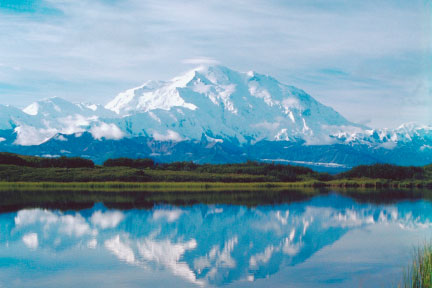
    • Of the 20 highest peaks in the United States, 17 are in Alaska, including the highest peak in North America (20,320 ft. above sea level), Denali.
    • Alaska contains more than 100 volcanoes and volcanic fields which have been active within the last two million years.
    • Alaska is the only state that does not collect state sales tax or levy an individual income tax (some cities have sales tax, however).
    • The fishing and seafood industry is the state’s largest private industry employer.
    • The largest salmon ever caught was at the Kenai River. It weighed in at 97.5 pounds.
    • There are more than 3,000 rivers and 3 million lakes in Alaska.
    49things-iliamna
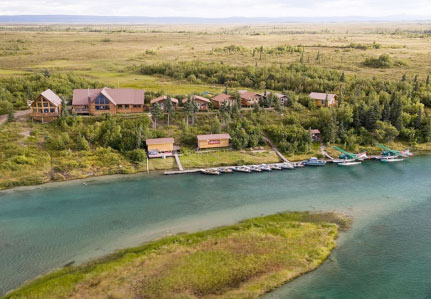
    • Alaska’s largest lake, Lake Iliamna, is roughly the size of Connecticut.
    • Alaska has more coastline than the rest of the United States combined (more than 34,000 miles).
    • Alaska has more inland water than any other state (20,171 square miles).
    • Alaska is the only state to have coastlines on three different seas: the Arctic Ocean, Pacific Ocean, and Bering Sea.
    • The state bird of Alaska is the willow ptarmigan.
    • During the Klondike gold rush in 1897, potatoes were so highly valued for their vitamin C content that miners traded gold for them.
    • The only battle during World War II that was fought on American soil took place in 1943 after the Japanese invaded the Aleutian Islands.
    • The state sport of Alaska is dog mushing, which was once the primary mode of transportation in most of Alaska. The Iditarod dog sledding race is the state’s largest sporting event.
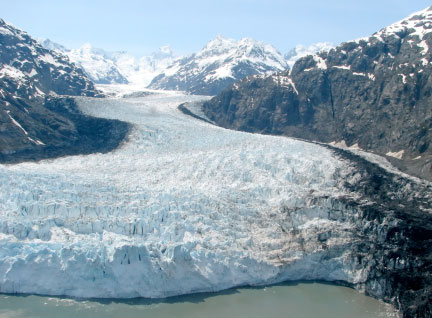
    • More than half the world’s glaciers can be found Alaska.
    49things-glacier
    • About 5 percent of Alaska is covered by the 1,000-plus glaciers in the state.
    • Alaska has the lowest population density in the nation at one person per square mile.
    • If New York City had the same population density as Alaska, only 16 people would be living in Manhattan.
    • Bennie Benson designed Alaska’s flag in 1926 at age 13. It would become the official state flag upon Alaska’s adoption into the Union in 1959.
    • Outsiders first discovered Alaska in 1741 when Danish explorer Vitus Jonassen Bering sighted it on a voyage from Siberia.
    • Barrow, 800 miles south of the North Pole, has both the longest and shortest day. When the sun rises on May 10, it doesn’t set for nearly three months. When it sets on November 18, Barrow residents do not see the sun again for nearly two months.
    • Each year Alaska has about 5,000 earthquakes including 1,000 that measure above 3.5 on the Richter scale. Of the 10 strongest earthquakes ever recorded in the world, three have occurred in Alaska, including a 9.2-magnitude temblor in 1964.
    • Giant vegetables are common in Alaska due to the extremely long days in summer. Alaska has grown a record cabbage weighing in at 94 pounds.
    • The Pribilof Islands are home to the largest seal colony with over one million seals.
    • About 52 percent of Alaskans are men – the highest percentage of any state.
    So there: you've been edified. :)
     
    Thanks for stopping by, friends.

    22 March 2015

    Sunday Fun Facts

    From the 2010 edition of the Alaska Visitors Guide:
    • Alaska has 39 mountain ranges, including 16 of the highest mountains in North America. Denali (Mt. McKinley to flatlanders) is king at 20,322 ft.
    • There are six mountain ranges visible from Anchorage including the Chugach Mountains, part of which is in Anchorage. The other five are the Alaska, Tordrillo, Aleutian, Talkeetna, and Kenai ranges.
    • Alaska has 30,000+ miles of shoreline, more than the rest of the U.S. combined.
    • We have about 100,000 glaciers; only 600 of them are named. (It doesn't say whether the others wander aimlessly, looking for handouts...)
    • The Aleutian arc contains 80 volcanoes; 40+ of them are active. Mt. Redoubt erupted in 2009, Mt. Spurr (75 miles west of Anchorage and often visible) erupted in 1992, depositing a layer of ash on Anchorage which remains today.
    • Alaska has 17 national parks, and the largest state park in the U.S. Wrangell-St. Elias is the largest national park at more than 13.2 million acres. That's double the size of Denali National Park, containing Mt. McKinley.
    • Speaking of Denali National Park, its roughly 9,500 square miles is contained entirely inside the Matanuska-Susitna Borough, which is north of Anchorage. The Mat-Su, or "The Valley" is 23,000 square miles - the same size as West Virginia, and is one of our medium-sized boroughs.
    • The Municipality of Anchorage is one of the smaller boroughs, containing 1,955 square miles - the size of Delaware.
    • Chugach National Forest, part of which is in Anchorage, is 5.6 million acres - roughly the size of Massachusetts and Rhode Island combined. It's the second largest in the nation.
    • The Tongass National Forest is the largest at 17 million acres, located in southeast Alaska.
    • The Chugach State Park is one of the largest in the country, at 500,000 acres.
    • And for you fisherfolk, the world record king salmon was caught here in 1985. It weighed 97 lbs, 4 oz.
    • The world record halibut was also caught here in 1996, weighing 459 pounds.
    That's enough oohs and aahs for one day. Don't want you overdoing it now, do we?

    25 November 2013

    In Lieu of Actual Blog Content...

    Alaska Facts:

    Native Eskimo and Aleut tribes inhabited the area before it was discovered by Vitus Bering, a Dane exploring for the Russians, in 1741. America bought Alaska from Russia in 1867. Gold was discovered in 1896 and the following Gold Rush drew many people — mostly men — to the area.

    Discoveries of oil and natural gas in 1968 led to a gold rush of another sort — one to plumb these natural resources. The Trans-Alaska pipeline was built and completed in 1977 at a cost of $7.7 billion. The wealth of income from the sale of oil led Alaska to give money back to all its tax-paying residents. An oil spill by an Exxon tanker in Prince William Sound in 1989 damaged pristine coastline and led to battles between environmentalists and the oil industry. The beautiful scenery, many national parks, and wildlife are Alaska’s main natural resources and tourist attractions.

    Alaska’s name is based on the Eskimo word Alakshak meaning great lands or peninsula. Or it's based on the word Alyeska, meaning much the same thing; depends on who you ask.

    Alaska is as big as England, France, Italy and Spain combined, or 2 1/2 times the size of Texas. That's approximately 586,400 square miles.

    Alaska has the lowest population density in the entire United States. The total population of the state is just under 700,000 710,231 (per the 2010 Census).

    More than half the world’s active glaciers are in Alaska.The interior of Alaska has over 50,000 glaciers, 3,000 rivers and three million lakes.

    Alaska contains 17 of the 20 highest peaks in The United States.

    The capital of Alaska is Juneau, the only capital city in the United States that is accessible by boat or plane only.

    The lowest temperature ever recorded in Alaska was -80F (-62C).

    Alaska has 2,670 named islands, and that many more without names*. Counting the islands, Alaska has approximately 44,000 miles of coastline.


    * My thanks to PioneerPreppy for suggesting this addition. :)

    21 March 2013

    Because You Asked

    I've received several recent inquiries about the weather here in Anchorage. Here's a handy-dandy chart I found on KTUU's weather page:
     
    Monthly Averages & Records - °F 
     
    DateAverage
    Low
    Average
    High
    Record
    Low
    Record
    High
    Average
    Precipitation
    Average
    Snow
    January22°-35° (1947)56° (1934)  0.68"9"
    February12°26°-38° (1947)57° (1943)  0.74"11"
    March18°34°-24° (1971)56° (1926)  0.65"10.3"
    April29°44°-15° (1920)72° (2005)  0.52"4.1"
    May39°55°1° (1945)82° (1947)  0.7"0.1"
    June47°62°29° (1920)92° (1931)  1.06"0"
    July52°65°34° (1922)84° (2003)  1.7"0"
    August49°63°31° (1984)85° (2004)  2.93"0"
    September41°55°19° (1992)73° (1957)  2.87"0.2"
    October28°40°-6° (1935)64° (2006)  2.09"8.5"
    November16°28°-21° (1956)62° (1920)  1.09"11.4"
    December11°24°-36° (1917)53° (1940)  1.05"14.9"

    12 December 2011

    Things You Probably Don't Know

    about Alaska:
    •  The first Olive Garden restaurant in Alaska will open here in Anchorage, next month.

    •  The International Pacific Halibut Commission has recommended limiting next year's catch to one per person, and wants to lower the commercial take from over 40 million to only 11 million. Why should you care, you ask? Because that will effectively triple (or more) the price of halibut throughout the entire country. Most of America's salmon, crab, halibut, and herring come from Alaska.
    •  
    •  In 1915 the record high temperature in Alaska was 100 degrees Fahrenheit at Fort Yukon; the record low temperature was -80 degrees Fahrenheit at Prospect Creek Camp in 1971.
    •  
    • Alaska has about one registered pilot for every 58 residents, six times as many pilots per capita and 14 times as many airplanes per capita as the rest of the United States.

    •  The Defense Department cuts you've been hearing so much about are having an effect. Alaska stands to lose 78 civilian positions. (I have to admit I'm having a bit of trouble worrying about that particular factoid, amongst all the other things clamoring for my attention.) Notice there's no reduction in troops - at least, not yet.
    •  
    •  There's an International Pacific Halibut Commission. Who knew?

    23 July 2009

    More Global Cooling

    Anchorage has been keeping weather data only since 1917, but here's a flying factoid: so far in 2009, we've experienced thirteen whole days when it got up to 70 degrees. That makes this the 13th warmest summer on record. Ooooh ... let the scorching begin!

    Climate change/global warming/whatever you want to call it, it's not exactly hot.