When we moved into our new house in 2016, my wife placed my Navy things in a new, more airtight tote ... whereupon I promptly lost track of it.
I finally remembered to ask her where it is, and dug some things out today.
Showing posts with label Adak. Show all posts
27 February 2018
29 January 2018
Another Adak Memory
Adak had a number of places which were off-limits (i.e., secret / top secret / or otherwise "authorized personnel only"). Some of those were guarded by the Marines. If you didn't have a pass, or your name didn't appear on that day's list of authorized visitors, you weren't getting in - and shouldn't try.
At one point in the spring of '76, COMNAVPACFLT came to visit. That's "Commander, U.S. Navy Pacific Fleet" to you landlubbers ... and that's A Big Deal to the sailors and Marines on the island. When the Commander of the Fleet shows up, you "snap to" like you've never snapped before!
The Commanding Officer of the Naval Station was showing the Admiral around the base, and they pulled up to one of those barbed-wire-and-armed-guard gates. The C.O. was always authorized to visit, so that wasn't a problem. But said Admiral's name did not appear on that day's list.
Without any further ado, the CO and the visiting Admiral found themselves face down in the snow, while the Marines sought identification and possible clearance for the unexpected guest.
Word of that event spread quickly around the base (and the Navy gossip mill makes mere office gossip seem to move at a snail's pace, in comparison). Sailors, in general, were aghast that the C.O.'s boss's boss was arrested and detained by the Marines.
Heads were gonna roll; we were sure of it.
Except that the Commandant of the Marine Barracks received a letter from the Admiral, commending him for how well the guards did their job. The Admiral wasn't on the list, and he knew it. It was a test, you see. If the guard(s) had allowed him in, no matter their reason, there would have been disciplinary hell to pay. No, the guards did their job in exemplary fashion.
And the gossip mill had fresh grist for a week. :)
15 November 2017
Navy Memories #16: Rounding the Edges & Filling In the Blanks
Previous installments:
We're nearing the end of my recollections of Navy days. Here are a few things I've left out along the way:
Memory #1:
While I was in Greece, there were two military coups. A third had occurred six months before I arrived, but the signs of it were still visible at the Athens national airport. The political climate was somewhat unstable during my 18 months there. Actually, that's putting it mildly, given the riots and the attempted fire-bombing of the U.S. Embassy. But here goes:
This was three months after the last one. By then, it was starting to feel familiar. ("What? The Greek army is shooting again? Must be Tuesday.")
* * * * *
I had been invited to an apartment taken by one of the petty officers I worked for, and one of the ship's two Hospital Corpsmen. (Note: Navy Corpsmen, like Army medics, are always called "Doc".) It was a part of Athens called Faliron, a rather-upscale neighborhood. That morning, I was supposed to walk the block or so to the neighborhood grocery store for something-or-other. But we awoke to reports on Armed Forces Radio of turmoil, scattered skirmishes, and general warnings to stay put, wherever we were, and wait for the "all clear" before attempting to travel.
The apartment building had a roof access, being only a couple of blocks from the Mediterranean, so we immediately went up to if anything was visible. A mile or so to the west, along the King George Highway, there was a very large roundabout. There were a few half-tracks, and a couple of tanks, blocking traffic. We could see troops milling about.
But directly in front of the apartment building was a man in a black trench coat, with an ugly-looking black machine gun. (In my experience, any machine gun pointed in my direction is ugly.) He waved it in our general direction and shouted something in Greek. "What did he say?" I asked as we retreated down the stairs.
"He said 'get your butts back in the house'," Doc said. And so we did, post-haste.
The next day, AFRN gave the all-clear, and we traveled the 17 miles back to the city of Elefsina where the ships were ported, without further incident.
* * * * *
#2:
Soon after, we traveled to Souda Bay in Crete. While there, a shipmate apparently consumed a bit too much of the Greek or Cypriot drink called ouzo. The clear stuff they sell in the States is available there, but what the Greeks drink is a black liquid. It's based on opium, so we were told at the time, and the locals sip at a shot of the stuff over the course of an evening.
The shipmate in question drank a lot in a short time, or so we were told, and totally lost it. He threw Doc's office chair overboard, and had to be restrained ... okay, handcuffed to a chair on the main deck where others could keep an eye on him. He indulged in some other behavior which resulted in being also covered with a blanket. 'Nuff said. Once back inside the ship, he was first restricted to a small compartment with a cargo net over the doorway, and eventually handcuffed to his rack (bunk). The next day, or perhaps later that same day; I've forgotten, he was taken off the ship in 'cuffs. I personally never heard about him again.
* * * * *
The remainder of my free time on Adak was spent enjoying the out-of-doors. Hiking, camping, and occasionally fishing.
And of course, there was the four-wheelin' off-roading which all those dirt roads and jeep trails provided.
Of course, that required a four-wheel drive vehicle. I spent so much time putting chains on that old Galaxy 500, the first winter - and subsequently taking them off, every three days; wash, rinse, repeat - that I was determined my second winter there would be different.
I watched the Adak Eagle's Call (the base newsletter) for ads, and checked the bulletin board at the Navy exchange. Eventually, I saw that a Lieutenant on the Coast Guard cutter had a '67 Bronco for sale. We met, and I drove and bought it.
There were about 12 or 13 miles of actual roads on the developed part of the island. That first weekend after buying the truck, I covered 189 miles ... literally a kid with a new toy.
The truck was a beater, but it had a powerful heater, good brakes and clutch, and the wipers worked. On Adak, those were necessities; anything else was icing on the cake.
I tried to stay on the established roads and paths, but not everyone did.
There were two off-road clubs: the Aleutian CB'ers (remember those?), and the Adak Four-Wheelin' Mud-Slingers.
The Mud-Slingers made a name for themselves - the wrong kind of name - in the fall of '76. They decided to take all dozen or so of their Jeeps, Land Cruisers, and pickups across a wide-open field. Travelling in a line abreast, they sank all 12 vehicles up to the frames in the thick, viscous mud gumbo which underlaid the tundra.
They radioed for help. Public Works sent a road grader to pull them out. It sank, too.
Then a Caterpillar 'dozer, which also became mired. Finally, two 'dozers, the grader, and several volunteers with four-wheel-drives were daisy-chained together, and pulled the Mud-Slingers out. One at a time.
The mess was horrible.
A side-note: tundra doesn't grow back. Well, to be fair, it does ... but very, very slowly. On Adak, there were bomb craters from WWII. The muddy bottoms were still exposed, more than 30 years after the war.
Captain Childers, Commanding Officer, was apoplectic, and issued a new directive. Henceforth, off-road travel was prohibited. We were free to follow any existing trails, but the next person to create a new one would be court-martialed.
Alrighty, then.
* * * * *
#5:
Yesterday, I solicited reader input for any final details, so I'll address a few now.
Q: Did you ever have something that constituted an actual military action or emergency (if such a thing can be told)?
A: I think being strafed by the Russian MiG in the Black Sea came pretty close. While 'Nam was winding down, we in the Mediterranean were in the Cold War. Our destroyers provided off-shore bombardment a few times, and coastal patrols (Yom Kippur War in '73, Cyprus uprising in '74). But the tin cans were primarily tasked with protecting the flat-tops - the carriers - so we chased a lot of submarines, and forced a few to the surface. But the number of times we fired ammo at live targets was pretty limited.
Q: How was your Christian persona received?
A: To be completely honest, I tried hard to run away from God in those years. He never let me get too far away, though, and always pulled me back ... sometimes kicking and yelling. But even at that, those closest to me knew I was a Christian, and I like to think that's responsible for the lasting friendships formed with those shipmates.
Q: How did you come to the pastorate?
A: I was called to ministry at the age of 12; I still remember that day very clearly. At 18, our local church licensed me as a minister. I had been serving as a lay minister, co-pastor and/or music minister for 15 years when I was ordained in 2000.
That's all there is, folks. I've written now about everything that wasn't classified, so unless I suddenly recall something else ...
Thank you for reading these posts. It's been fun playing "Remember when ..?", and I'm glad you enjoyed it, too.
- Boot Camp Memories
- About Those Navy Memories
- First Orders
- Anchor's Aweigh
- Man Overboard!
- Reflections of a Black Shoe
- Destroyer Life and Ports of Call
- Warships vs. Big Waves
- The Accident, and More Ports of Call
- The Black Sea - Operation Silver Fox
- 1975, A Year of Change
- North to the Future
- Adak Outdoors
- Adak Life
- Adak Work, Winter, and More
We're nearing the end of my recollections of Navy days. Here are a few things I've left out along the way:
Memory #1:
While I was in Greece, there were two military coups. A third had occurred six months before I arrived, but the signs of it were still visible at the Athens national airport. The political climate was somewhat unstable during my 18 months there. Actually, that's putting it mildly, given the riots and the attempted fire-bombing of the U.S. Embassy. But here goes:
- The Velos mutiny (el) on 23 May 1973 against the Regime of the Colonels. The crew of the destroyer HNS Velos (D-16), under the command of Nikolaos Pappas, demanded political asylum in Italy, while the rest of the mutiny in Greek territory is suppressed;
This would be the event which left bullet holes in the airport walls, which I saw when first arriving in Athens at the Greek National Airport.
- 1973 Greek coup d'état (el) on 25 November 1973, in the aftermath of the Athens Polytechnic uprising. The coup resulted in overthrow of Colonel Papadopoulos by hardliners around General Dimitrios Ioannidis;
This was three days after my arrival. Nothing says "Welcome to our country!" like an armed uprising. :)
- Pyjamas coup on 24 February 1975, attempt by certain officers to overthrow the government of Konstantinos Karamanlis.
This was three months after the last one. By then, it was starting to feel familiar. ("What? The Greek army is shooting again? Must be Tuesday.")
* * * * *
I had been invited to an apartment taken by one of the petty officers I worked for, and one of the ship's two Hospital Corpsmen. (Note: Navy Corpsmen, like Army medics, are always called "Doc".) It was a part of Athens called Faliron, a rather-upscale neighborhood. That morning, I was supposed to walk the block or so to the neighborhood grocery store for something-or-other. But we awoke to reports on Armed Forces Radio of turmoil, scattered skirmishes, and general warnings to stay put, wherever we were, and wait for the "all clear" before attempting to travel.
![]() |
| The Palaio Faliro (Faliron) district of Athens - this view is only a few blocks from the apartment in this story. |
The apartment building had a roof access, being only a couple of blocks from the Mediterranean, so we immediately went up to if anything was visible. A mile or so to the west, along the King George Highway, there was a very large roundabout. There were a few half-tracks, and a couple of tanks, blocking traffic. We could see troops milling about.
But directly in front of the apartment building was a man in a black trench coat, with an ugly-looking black machine gun. (In my experience, any machine gun pointed in my direction is ugly.) He waved it in our general direction and shouted something in Greek. "What did he say?" I asked as we retreated down the stairs.
"He said 'get your butts back in the house'," Doc said. And so we did, post-haste.
The next day, AFRN gave the all-clear, and we traveled the 17 miles back to the city of Elefsina where the ships were ported, without further incident.
* * * * *
#2:
Soon after, we traveled to Souda Bay in Crete. While there, a shipmate apparently consumed a bit too much of the Greek or Cypriot drink called ouzo. The clear stuff they sell in the States is available there, but what the Greeks drink is a black liquid. It's based on opium, so we were told at the time, and the locals sip at a shot of the stuff over the course of an evening.
The shipmate in question drank a lot in a short time, or so we were told, and totally lost it. He threw Doc's office chair overboard, and had to be restrained ... okay, handcuffed to a chair on the main deck where others could keep an eye on him. He indulged in some other behavior which resulted in being also covered with a blanket. 'Nuff said. Once back inside the ship, he was first restricted to a small compartment with a cargo net over the doorway, and eventually handcuffed to his rack (bunk). The next day, or perhaps later that same day; I've forgotten, he was taken off the ship in 'cuffs. I personally never heard about him again.
* * * * *
#3:
Now, fast-forward a couple of years ...
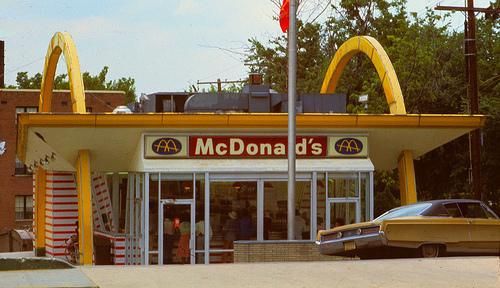
You may recall me mentioning that while McDonald's eventually made it to Adak, it wasn't there during my two years on the island.
In the Mediterranean, one nickname we had for "the States" was "the land of the round doorknob." The European lever-type knobs hadn't made it to the States yet. But both in the Med and on Adak, we also called it "the Land of the Big Mac". Sailors ... okay, American enlisted, period ... always wax nostalgic for whatever they can't acquire locally.
The idea of a Big Mac and McDonald's fries was a very appealing daydream to sailors stationed on the wrong side of the planet, where such was not available without making a very long flight, across multiple time zones. We talked about them frequently; you can trust me on this.
An example: in 1974, a shipmate brought back two Big Macs in his suitcase when he returned to Athens. Even 18 hours old, and a little smashed, it was the best thing I'd eaten in weeks. At least I thought so, at the time.
So in late '75, a rumor began circulating wildly across Adak: some entrepreneurial officers had pooled their resources, requisitioned or chartered a cargo plane, and would fly in with 5,000 Big Macs.
This wasn't just a big deal; it was a BIG. DEAL.
The day the plane landed, there were hundreds and hundreds of sailors and civilians lined up. As soon as the plane taxied to a stop, the line formed almost at the foot of the stairs.
They sold those sandwiches, several hours old at that point, for five bucks apiece ... and sold out very, very quickly.
Me? I only bought five.
What's that? Why yes, I did eat them all that evening. Didn't want 'em to get stale, don'tcha know.
* * * * *
Now, fast-forward a couple of years ...
You may recall me mentioning that while McDonald's eventually made it to Adak, it wasn't there during my two years on the island.
In the Mediterranean, one nickname we had for "the States" was "the land of the round doorknob." The European lever-type knobs hadn't made it to the States yet. But both in the Med and on Adak, we also called it "the Land of the Big Mac". Sailors ... okay, American enlisted, period ... always wax nostalgic for whatever they can't acquire locally.
![]() |
| The 1970s ... remember, kids? |
The idea of a Big Mac and McDonald's fries was a very appealing daydream to sailors stationed on the wrong side of the planet, where such was not available without making a very long flight, across multiple time zones. We talked about them frequently; you can trust me on this.
An example: in 1974, a shipmate brought back two Big Macs in his suitcase when he returned to Athens. Even 18 hours old, and a little smashed, it was the best thing I'd eaten in weeks. At least I thought so, at the time.
![]() |
| Before inflation... |
So in late '75, a rumor began circulating wildly across Adak: some entrepreneurial officers had pooled their resources, requisitioned or chartered a cargo plane, and would fly in with 5,000 Big Macs.
This wasn't just a big deal; it was a BIG. DEAL.
The day the plane landed, there were hundreds and hundreds of sailors and civilians lined up. As soon as the plane taxied to a stop, the line formed almost at the foot of the stairs.
They sold those sandwiches, several hours old at that point, for five bucks apiece ... and sold out very, very quickly.
Me? I only bought five.
What's that? Why yes, I did eat them all that evening. Didn't want 'em to get stale, don'tcha know.
* * * * *
#4:
The remainder of my free time on Adak was spent enjoying the out-of-doors. Hiking, camping, and occasionally fishing.
And of course, there was the four-wheelin' off-roading which all those dirt roads and jeep trails provided.
Of course, that required a four-wheel drive vehicle. I spent so much time putting chains on that old Galaxy 500, the first winter - and subsequently taking them off, every three days; wash, rinse, repeat - that I was determined my second winter there would be different.
I watched the Adak Eagle's Call (the base newsletter) for ads, and checked the bulletin board at the Navy exchange. Eventually, I saw that a Lieutenant on the Coast Guard cutter had a '67 Bronco for sale. We met, and I drove and bought it.
![]() |
| Solid mechanically; the body was bit the worse for several years of Aleutian weather, and Adak drivers. Still I thought it was the prettiest thing I'd ever seen. "No more tire chains!" |
There were about 12 or 13 miles of actual roads on the developed part of the island. That first weekend after buying the truck, I covered 189 miles ... literally a kid with a new toy.
The truck was a beater, but it had a powerful heater, good brakes and clutch, and the wipers worked. On Adak, those were necessities; anything else was icing on the cake.
I tried to stay on the established roads and paths, but not everyone did.
There were two off-road clubs: the Aleutian CB'ers (remember those?), and the Adak Four-Wheelin' Mud-Slingers.
The Mud-Slingers made a name for themselves - the wrong kind of name - in the fall of '76. They decided to take all dozen or so of their Jeeps, Land Cruisers, and pickups across a wide-open field. Travelling in a line abreast, they sank all 12 vehicles up to the frames in the thick, viscous mud gumbo which underlaid the tundra.
They radioed for help. Public Works sent a road grader to pull them out. It sank, too.
Then a Caterpillar 'dozer, which also became mired. Finally, two 'dozers, the grader, and several volunteers with four-wheel-drives were daisy-chained together, and pulled the Mud-Slingers out. One at a time.
The mess was horrible.
A side-note: tundra doesn't grow back. Well, to be fair, it does ... but very, very slowly. On Adak, there were bomb craters from WWII. The muddy bottoms were still exposed, more than 30 years after the war.
Captain Childers, Commanding Officer, was apoplectic, and issued a new directive. Henceforth, off-road travel was prohibited. We were free to follow any existing trails, but the next person to create a new one would be court-martialed.
Alrighty, then.
* * * * *
#5:
Yesterday, I solicited reader input for any final details, so I'll address a few now.
Q: Did you ever have something that constituted an actual military action or emergency (if such a thing can be told)?
A: I think being strafed by the Russian MiG in the Black Sea came pretty close. While 'Nam was winding down, we in the Mediterranean were in the Cold War. Our destroyers provided off-shore bombardment a few times, and coastal patrols (Yom Kippur War in '73, Cyprus uprising in '74). But the tin cans were primarily tasked with protecting the flat-tops - the carriers - so we chased a lot of submarines, and forced a few to the surface. But the number of times we fired ammo at live targets was pretty limited.
Q: How was your Christian persona received?
A: To be completely honest, I tried hard to run away from God in those years. He never let me get too far away, though, and always pulled me back ... sometimes kicking and yelling. But even at that, those closest to me knew I was a Christian, and I like to think that's responsible for the lasting friendships formed with those shipmates.
Q: How did you come to the pastorate?
A: I was called to ministry at the age of 12; I still remember that day very clearly. At 18, our local church licensed me as a minister. I had been serving as a lay minister, co-pastor and/or music minister for 15 years when I was ordained in 2000.
That's all there is, folks. I've written now about everything that wasn't classified, so unless I suddenly recall something else ...
Thank you for reading these posts. It's been fun playing "Remember when ..?", and I'm glad you enjoyed it, too.
03 November 2017
Navy Memories #15: Adak Work, Winter, and More
Previous installments:
That first long, Aleutian winter dragged on. Heavy snows, strong winds ... digging out the car, putting on chains. Two- and three-foot deep snows were common, hitting every 3 or 4 days.
We were expected to make it to work on time; it's the military, after all, and we weren't excused just because the weather had turned mean. The Security forces drove Dodge Power Wagons with lift kits and large tires, and so did the Executive Officer. If he could make it to work, then it was not a day off.
Personally, I always thought that was a bit unfair. 99 per cent of the sailors on the base drove regular cars or four-by-fours, not lifted trucks. The average personal vehicle didn't have two feet of ground clearance, but that's how it goes.
* * * * *
Foot travel in the winter was difficult. The winds blew almost constantly, and one had to lean sharply into the wind to stay upright.
But williwaws made it tough: you could be walking along, and the wind would stop suddenly. Already leaning forward into that wind, you would start to fall, and then the wind would return from the opposite direction, pushing you onto your face. That was ... unpleasant. And it happened just often enough to be really annoying.
But for driving, there were four levels of "road condition":
- Boot Camp Memories
- About Those Navy Memories
- First Orders
- Anchor's Aweigh
- Man Overboard!
- Reflections of a Black Shoe
- Destroyer Life and Ports of Call
- Warships vs. Big Waves
- The Accident, and More Ports of Call
- The Black Sea - Operation Silver Fox
- 1975, A Year of Change
- North to the Future
- Adak Outdoors
- Adak Life
![]() |
| Location of Adak Island in the Aleutians |
We were expected to make it to work on time; it's the military, after all, and we weren't excused just because the weather had turned mean. The Security forces drove Dodge Power Wagons with lift kits and large tires, and so did the Executive Officer. If he could make it to work, then it was not a day off.
![]() |
| NOT a Navy truck, but you get the idea. |
Personally, I always thought that was a bit unfair. 99 per cent of the sailors on the base drove regular cars or four-by-fours, not lifted trucks. The average personal vehicle didn't have two feet of ground clearance, but that's how it goes.
* * * * *
Williwaw: 2. strong winds which blow from one direction, stop suddenly, and then blow just as strongly from the opposite direction
Foot travel in the winter was difficult. The winds blew almost constantly, and one had to lean sharply into the wind to stay upright.
But williwaws made it tough: you could be walking along, and the wind would stop suddenly. Already leaning forward into that wind, you would start to fall, and then the wind would return from the opposite direction, pushing you onto your face. That was ... unpleasant. And it happened just often enough to be really annoying.
But for driving, there were four levels of "road condition":
- Delta - normal conditions, roads are clear
- Charlie - snow-covered, use caution (this was the normal winter condition)
- Bravo - chains or four-wheel-drive required (travel to/from work or grocery store only)
- Alpha - roads are closed; do NOT attempt to drive
In winter time, these conditions were announced on the radio every morning. We all prayed for Road Condition Alpha, of course, but it rarely happened. I only recall Alpha occurring once in the two years I was there.
* * * * *
In my previous post, I wrote about volunteer work at the radio and TV stations. But most weekends were spent driving around, or camping and hiking, depending on the weather.
Driving on Adak could be challenging. In winter, you had to use four-wheel-drive just to get out of the parking lot, as it was rarely plowed. The on-base roads were kept as clear as possible, but sailors who parked at the barracks were on their own. I kept a snow shovel and a broom in my truck, just for digging out.
But driving off-base was always an adventure.
For that matter, walking off-base wasn't for the faint of heart, either. More than once I set off with backpack, only to have snow move in and go from flurries to mid-thigh deep in 15 or 20 minutes. That was a "go back to the barracks and try another day" moment.
I asked a Navy buddy from Adak if he remembered anything about that sort of thing, and this was his reply:
I don't remember now why we didn't light a fire (it's been 41 years, so forgive me) but it's safe to say that any scrap lumber in the area would have been under a few feet of snow by that point, and hard to find at the very least.
I had a small tent in my pack, but couldn't set it up on the wood floor. This was long before tents came with fiberglass poles, and needed pegs and guy-wires to stay up. Just the same, I wish I'd known Craig was that cold. We could have pulled up a section of flooring to burn for heat; wouldn't have bothered me a bit.
* * * * *
Adak was such a starkly beautiful place. The mountains, streams, lakes, the ocean ... just so gosh-darn photogenic!
Adak had a number of places which were off-limits (i.e., secret / top secret / or otherwise "authorized personnel only"). Some of those were guarded by the Marines. If you didn't have a pass, or your name didn't appear on that day's list of authorized visitors, you weren't getting in - and shouldn't try.
At one point in the spring of '76, COMNAVPACFLT came to visit. That's "Commander, U.S. Navy Pacific Fleet" to you landlubbers ... and that's A Big Deal to the sailors and Marines on the island. When the Commander of the Fleet shows up, you snap to like you've never snapped before!
The Commanding Officer of the Naval Station was showing the Admiral around the base, and they pulled up to one of those barbed-wire-and-armed-guard gates. The C.O. was always authorized to visit, so that wasn't a problem. But said Admiral's name did not appear on that day's list.
Without any further ado, the CO and the visiting Admiral found themselves face down in the snow, while the Marines sought identification and possible clearance for the unexpected guest.
Word of that event spread quickly around the base (and the Navy rumor mill makes office gossip seem like a snail's pace, in comparison). Sailors, in general, were aghast that the C.O.'s boss's boss was arrested and detained by the Marines.
Heads were gonna roll; we were sure of it.
Except that the Commandant of the Marine Barracks received a letter from the Admiral, commending him for how well the guards did their job. He wasn't on the list, and he knew it. It was a test, you see. If the guard(s) had allowed him in, no matter their reason, there'd have been disciplinary hell to pay.
But the guards did their job in exemplary fashion.
And the rumor mill had fresh grist for a week. :)
Driving on Adak could be challenging. In winter, you had to use four-wheel-drive just to get out of the parking lot, as it was rarely plowed. The on-base roads were kept as clear as possible, but sailors who parked at the barracks were on their own. I kept a snow shovel and a broom in my truck, just for digging out.
But driving off-base was always an adventure.
For that matter, walking off-base wasn't for the faint of heart, either. More than once I set off with backpack, only to have snow move in and go from flurries to mid-thigh deep in 15 or 20 minutes. That was a "go back to the barracks and try another day" moment.
I asked a Navy buddy from Adak if he remembered anything about that sort of thing, and this was his reply:
I remember that you and I backpacked to the cabin late one winter's evening. The snow was deep and the night was really dark and cold. About 15°, if I remember correctly. When we arrived at the cabin, we found that the door had been kicked open, and the drift was piled as high as the door. We climbed over and then slid down the opening into the cabin.
By that time you were chilled, so you immediately rolled out your goose down mummy bag on a foam pad, and climbed inside to get warm. I had a borrowed sleeping bag, and did the same. I didn't get much sleep that night, in a summer bag on the wooden floor. You slept soundly in the goose down.
Craig P.
I don't remember now why we didn't light a fire (it's been 41 years, so forgive me) but it's safe to say that any scrap lumber in the area would have been under a few feet of snow by that point, and hard to find at the very least.
I had a small tent in my pack, but couldn't set it up on the wood floor. This was long before tents came with fiberglass poles, and needed pegs and guy-wires to stay up. Just the same, I wish I'd known Craig was that cold. We could have pulled up a section of flooring to burn for heat; wouldn't have bothered me a bit.
* * * * *
Adak was such a starkly beautiful place. The mountains, streams, lakes, the ocean ... just so gosh-darn photogenic!
Adak had a number of places which were off-limits (i.e., secret / top secret / or otherwise "authorized personnel only"). Some of those were guarded by the Marines. If you didn't have a pass, or your name didn't appear on that day's list of authorized visitors, you weren't getting in - and shouldn't try.
At one point in the spring of '76, COMNAVPACFLT came to visit. That's "Commander, U.S. Navy Pacific Fleet" to you landlubbers ... and that's A Big Deal to the sailors and Marines on the island. When the Commander of the Fleet shows up, you snap to like you've never snapped before!
The Commanding Officer of the Naval Station was showing the Admiral around the base, and they pulled up to one of those barbed-wire-and-armed-guard gates. The C.O. was always authorized to visit, so that wasn't a problem. But said Admiral's name did not appear on that day's list.
Without any further ado, the CO and the visiting Admiral found themselves face down in the snow, while the Marines sought identification and possible clearance for the unexpected guest.
Word of that event spread quickly around the base (and the Navy rumor mill makes office gossip seem like a snail's pace, in comparison). Sailors, in general, were aghast that the C.O.'s boss's boss was arrested and detained by the Marines.
Heads were gonna roll; we were sure of it.
Except that the Commandant of the Marine Barracks received a letter from the Admiral, commending him for how well the guards did their job. He wasn't on the list, and he knew it. It was a test, you see. If the guard(s) had allowed him in, no matter their reason, there'd have been disciplinary hell to pay.
But the guards did their job in exemplary fashion.
And the rumor mill had fresh grist for a week. :)
23 October 2017
Navy Memories #14: Adak Life
Previous installments:
I make a couple of opening remarks, in the best Vulcan voice I could offer, and introduced each episode.
We'd ask folks to call in after each episode, just to see if anyone was watching. A few managed to stay with us, so we ran all 8 episodes.
And no, there's no footage, or recording, or any other evidence beyond what I've reproduced here.
That's probably a good thing, for all involved.
* * * * *
- Boot Camp Memories
- About Those Navy Memories
- First Orders
- Anchor's Aweigh
- Man Overboard!
- Reflections of a Black Shoe
- Destroyer Life and Ports of Call
- Warships vs. Big Waves
- The Accident, and More Ports of Call
- The Black Sea - Operation Silver Fox
- 1975, A Year of Change
- North to the Future
- Adak Outdoors
Note to readers: sorry for the delay in posting this. Life, as usual, gets in the way.
Summer on Adak was a predictable season, or so it seemed. The tundra turned green right around June 15, and turned brown again on September 15. I know it sounds funny, but it was that way for both summers for which I was there.
Even though my first summer and winter were spent driving that old Ford Galaxy (picture in previous post), I drove as far as the roads permitted a sedan to go. I watched the various CJs, Land Cruisers, pickups and other 4x4 vehicles heading gleefully into the old Jeep trails, and have to admit to a certain longing.
My first winter on Adak was an adventure in deep snow, and how to get around in it. We'd get three feet of snow, it stayed on the ground for a day or two, and then a warm-up which quickly melted most of the drifts, turning unpaved roads and parking areas into mud pits.
(chinook: a warm moist southwest wind )
Then at night, cold air settled back in, and we awoke to another three-plus feet dump of snow.
(williwaw: a sudden violent gust of cold land air common along mountainous coasts of high latitudes)
![]() |
| The day after another snowstorm |
I managed through that first winter, driving that Ford, and putting on chains every time it snowed. That got old pretty quickly, and I determined to buy something - anything - with four-wheel drive as soon as I could.
Choices were limited by budget, then as now, and an E-4 with two years of service only got paid $459.30/month at that time. So I started saving my pennies, with high hopes. :)
I mentioned in the previous post that I selected one of the old Quonset huts as a home-away-from-home. A large bag of 6-penny nails, a three-pound hammer, a fanny pack, and big dreams of a "cabin in the tundra" were in my future.
It turned out that another sailor who had also been stationed in Athens arrived on the island soon after I did. We struck up a friendship based on that shared experience, and he thought a cabin was a good idea, too.
I described, last time, what we actually accomplished ... as opposed to what we thought we could do. It was a shell, with a 55-gallon drum for a wood stove, and two metal cots. We didn't even have chairs.
Mike seemed to lose interest thereafter (I can't blame him) and I only stayed there a few times, myself. It was warm enough, once the old metal drum and galvanized pipe got hot enough to send smoke vertically, instead of through the sides. I learned to light a fire, then go outside for 10 or 15 minutes before re-entering.
As long as dry wood was fed into the "stove" every 60 to 90 minutes, it heated okay.
* * * * *
But the heavy snows prevented me from a lot of winter travel, so I looked for things to do indoors.
The barracks were located on Bering Hill, above the base, and there was a huge recreation building and chow hall. All of the buildings on Bering Hill - and there were a lot of barracks - were connected with tunnels. No one had to go outside to get from one place to another, unless they wanted to.
Rather a nice idea, in a place with heavy snows and 100 mph winds.
The Hall had a pizzeria, a hamburger joint, movie theater, swimming pool, and other such things. Adak got McDonald's, eventually, but not during my time.
So.
The local outlet of the Armed Forces Radio and Television Service (AFRTS, or A-Farts, if you'll pardon the military expression) was in the basement. I had a friend who had a friend, and found myself hanging out at the radio station frequently.
![]() |
| The broadcast booth TV control console. |
Most of you won't know this unless I tell you: I have a deep voice which sounds good on the radio, so I'm told. So I wound up filling in for the morning D.J. when he suffered a back injury.
"Good morning - it's time for the Dawnbuster!" rang the mellifluous, pear-shaped tones of the early a.m. jocks, and I did the same. Mostly, it consisted of playing tape carts of theme music, the Paul Harvey radio program which was relayed via telephone from Anchorage some 1,350 miles away, and various public interest announcements and military news. Honestly, it wasn't nearly as big a deal as it sounds.
I recorded some faux spots as well. One which comes to mind consisted of a spectacular orchestral fanfare, building to a crescendo before ending suddenly ... to wit:
(Cue music)
The 1976 Annual Pillsbury Bake-off begins next week from lovely midtown Manhattan...
(music gets louder)
.. as housewives, homemakers, and cooks from all over create their most delicious, creative cakes, cookies, pies and desserts.
(music ends with tremendous flourish)
(in silence) ... Yum, YUM!
I guess you had to hear it; it sounded better than it reads. :)
But that also lead to hanging around the TV station with my friend Bob M., and talking to folks, and expressing interest, and ... see where this is going?
Bob and I were Star Trek geeks, in those days. TV shows were sent out by the Navy on very large, reel-to-reel spools. Typically, the station would receive 8 episodes in each shipment.
In the spring of '76, Bob and I decided to put on the First Annual All-Night Westernmost Star Trek Film Festival. The powers-that-be approved, and ... well, the rest was history.
![]() |
| Make-up test, early in the day. |
![]() |
| In make-up, in front of the backdrop which served as the set. |
We'd ask folks to call in after each episode, just to see if anyone was watching. A few managed to stay with us, so we ran all 8 episodes.
And no, there's no footage, or recording, or any other evidence beyond what I've reproduced here.
That's probably a good thing, for all involved.
* * * * *
That's how my friends and I occupied our time during that first winter. It was radically different from shipboard life, and I loved it. The wild, undeveloped Aleutians, the wild weather, the wide-open spaces ...
What's not to like?
11 September 2017
Navy Memories #13: Adak Outdoors
Previous installments:
If you ask anyone who was stationed in the Aleutians, they'll talk about the weather, the fishing, and the roads. Not necessarily in that order, but trust me - those three things will be among the first things they mention.
Adak, situated smack-dab in the middle of the Aleutian chain, is 650 miles from the Alaskan mainland. The Aleutians are also used by cartographers as the boundary between the north Pacific and the Bering Sea.
I already wrote about the elements which form the basis for Adak's wild weather patterns (see #12, above). When I was there, we had some 270 days per year of measurable precipitation, and sunny days were rare. So yes, the weather plays a BIG part in anyone's experience there.
There weren't many roads on the island, apart from the Naval Station itself. The roads off-base were dirt and gravel. You can imagine what all that rain and snow did to dirt roads. According to one crusty old Chief Warrant Officer, "I see they've relocated all the potholes."
The Main Road ... always referred to with capital letters ... was a two-lane blacktop that ran from Bering Hill, around the southern end of the runway, and north again to the edge of the base. It forked just north of the Station; the eastern fork continued along the coast to the Naval Communication Station (see map - it's labeled "NSAG" for Naval Security Activities Group), and beyond. To get anywhere off-base, one traveled either a dirt road, or went hiking.
There were about 12 miles of road, excluding the streets in the residential areas, and only some 3 1/2 miles of it was paved.
I drove 189 miles on those roads, one weekend ... we'll get back to that in a later installment.
"Birthplace of the Winds"
On any day when the winds blew at less than 40 knots (46 mph), it was considered a normal day. That doesn't mean a 40-knot wind wouldn't go straight through whatever outer wear you selected. I soon discovered that the Navy's standard foul weather coat was woefully inadequate. But a quick trip to the Supply Division had me digging through non-standard wear ... I found an Air Force parka with a snorkel hood that worked very well. A "snorkel" hood is one which, when unfolded or unrolled, extends out past your face to create a space where the weather doesn't reach you. Of course, you get tunnel vision, but that's how snorkels are. :)
But the winds were the big story, most of the time. You could walk across a lot in the rain (have I mentioned it rained horizontally?) and get wet on only one side. In winter, you'd have snow caked on one side. There were days when it blew so hard that many would link elbows to get across the parking lots; it kept the smaller folk from blowing away. That's no joke.
One popular pastime was to go onto any parking lot in winter, with your back to the wind, and open your coat. You could slide, skate, or tumble very quickly to the other side! Okay, it was an acquired skill ... but it was a lot of fun!
There was a particular day in my second year when the winds were blowing at 60 to 70 knots (69 to 80 mph), and gusting over 100 knots (115 mph). We were sent home at mid-day because the weather service expected the storm to worsen.
Several of us piled into my 4x4 (my second vehicle on Adak) to head back to the barracks. Once on the main road, I realized that the wind would be behind us for the first half-mile. We turned off the engine, opened the doors, hung onto them for dear life ... and continued at 45 mph without slowing!
Weekend Activities
A popular pastime for many was the adoption of a Quonset hut.
At one point during World War II, there were around 90,000 troops stationed on Adak. The original quarters were canvas tents, but those didn't stand up to the wind and snow very well. So the next option was Quonset huts ... and the Navy built a LOT of them. Each was spacious, and many servicemen could be quartered in each one.
The enlisted huts were a thick pressboard, with inner and outer layers, and insulation in-between. The officers' huts had metal siding. We enlisted men took a perverse pleasure in noting that, in the '70s, that the enlisted huts had resisted the weather much better than the metal-sided version. Many of those had collapsed by then.
So what do off-duty personnel do, 650 miles out in the middle of the ocean? Why, we salvaged materials from collapsed huts and rebuilt Quonsets for ourselves. Some got pretty fancy, indeed. The base Security office had aerial photos of all the huts, and all they asked was that we stop by to tell them which one we'd "adopted".
Mine wasn't as nice as the one pictured above, but it was weather tight, and we found a 55-gallon drum and enough galvanized stove pipe to make a wood stove. We salvaged flooring from other huts, and a couple of metal cots to sleep on. A Coleman lamp, well-seasoned lumber from collapsed huts, and we were good to go. It was a quiet shelter from the wind or cold, and I spent a night there, from time to time.
But the weather was always an issue. I was always amazed at how quickly snow could accumulate. One Saturday, I headed out to the hut to install more flooring. It had just begun flurrying, and there were two- to three-inch tall drifts across the road already.
I parked my old Ford Galaxy about 1/8 mile away, and spent the next 90 minutes nailing down some flooring. When I went back outside, the snow was up to the door handles on the car.
I'd had the car for awhile, and since it was mid-winter, also had quite a bit of experience at how to get it going.
1: Get the snow shovel out of the trunk.
2: Dig a trench around the car.
3: Jack up each rear tire and put the snow chains on.
That was a fairly quick procedure, given the amount of practice I'd already had. But then I faced a new challenge. Each time I'd done it, previously, I was on-base, and the Facilities folks had already plowed the roads.
On Adak, they used road graders on the base for snow plows. Off-base? They used D-7 Caterpillars.
The road was now one with the surrounding landscape; there was a solid, three-foot-deep landscape of snow as far as I could see.
But then the Lord smiled on me, and what was at first a distant rumble became a very large D7 Caterpillar which was headed toward the base. I waited for him to chug by, and followed him back into town.
By the way, the reason I'd had so much practice putting the snow chains on the car was because the parking lot at the barracks was never cleared unless we did it ourselves. I got good at rocking the car back and forth, with chains on, until I created enough room to get up a bit of headway. That allowed me to churn through the snow and make my own path to the plowed road at the edge.
But getting outside was its own reward. The landscape is spectacular in summer and winter alike.
And wildlife?
Caribou, with no natural predators save Man ... Arctic fox ... ptarmigan ... the largest aerie of Bald Eagles in North America (or so we were told at the time), with some 5,000 of the raptors present. There were ravens ... seagulls ... several kinds of salmon ... Dolly Varden ... halibut.
Shellfish? No. There are mussels, but those are poisonous in the Aleutians.
In fact, you can eat almost anything you find there. With minimal instruction, one can live off the land quite nicely.
It's a sportsman's paradise, very photogenic, and it touched everyone who's ever been there.
Next installment: I get involved in radio and TV.
(h/t RCM for editing suggestions)
- Boot Camp Memories
- About Those Navy Memories
- First Orders
- Anchor's Aweigh
- Man Overboard!
- Reflections of a Black Shoe
- Destroyer Life and Ports of Call
- Warships vs. Big Waves
- The Accident, and More Ports of Call
- The Black Sea - Operation Silver Fox
- 1975, A Year of Change
- North to the Future
![]() |
| Sign above the entrance to the airport terminal from the runway. |
If you ask anyone who was stationed in the Aleutians, they'll talk about the weather, the fishing, and the roads. Not necessarily in that order, but trust me - those three things will be among the first things they mention.
Adak, situated smack-dab in the middle of the Aleutian chain, is 650 miles from the Alaskan mainland. The Aleutians are also used by cartographers as the boundary between the north Pacific and the Bering Sea.
I already wrote about the elements which form the basis for Adak's wild weather patterns (see #12, above). When I was there, we had some 270 days per year of measurable precipitation, and sunny days were rare. So yes, the weather plays a BIG part in anyone's experience there.
There weren't many roads on the island, apart from the Naval Station itself. The roads off-base were dirt and gravel. You can imagine what all that rain and snow did to dirt roads. According to one crusty old Chief Warrant Officer, "I see they've relocated all the potholes."
The Main Road ... always referred to with capital letters ... was a two-lane blacktop that ran from Bering Hill, around the southern end of the runway, and north again to the edge of the base. It forked just north of the Station; the eastern fork continued along the coast to the Naval Communication Station (see map - it's labeled "NSAG" for Naval Security Activities Group), and beyond. To get anywhere off-base, one traveled either a dirt road, or went hiking.
There were about 12 miles of road, excluding the streets in the residential areas, and only some 3 1/2 miles of it was paved.
I drove 189 miles on those roads, one weekend ... we'll get back to that in a later installment.
"Birthplace of the Winds"
![]() |
| Official station patch |
![]() |
| a "snorkel" parka |
But the winds were the big story, most of the time. You could walk across a lot in the rain (have I mentioned it rained horizontally?) and get wet on only one side. In winter, you'd have snow caked on one side. There were days when it blew so hard that many would link elbows to get across the parking lots; it kept the smaller folk from blowing away. That's no joke.
One popular pastime was to go onto any parking lot in winter, with your back to the wind, and open your coat. You could slide, skate, or tumble very quickly to the other side! Okay, it was an acquired skill ... but it was a lot of fun!
There was a particular day in my second year when the winds were blowing at 60 to 70 knots (69 to 80 mph), and gusting over 100 knots (115 mph). We were sent home at mid-day because the weather service expected the storm to worsen.
Several of us piled into my 4x4 (my second vehicle on Adak) to head back to the barracks. Once on the main road, I realized that the wind would be behind us for the first half-mile. We turned off the engine, opened the doors, hung onto them for dear life ... and continued at 45 mph without slowing!
Weekend Activities
A popular pastime for many was the adoption of a Quonset hut.
At one point during World War II, there were around 90,000 troops stationed on Adak. The original quarters were canvas tents, but those didn't stand up to the wind and snow very well. So the next option was Quonset huts ... and the Navy built a LOT of them. Each was spacious, and many servicemen could be quartered in each one.
![]() |
| Adak, c. 1945 |
The enlisted huts were a thick pressboard, with inner and outer layers, and insulation in-between. The officers' huts had metal siding. We enlisted men took a perverse pleasure in noting that, in the '70s, that the enlisted huts had resisted the weather much better than the metal-sided version. Many of those had collapsed by then.
So what do off-duty personnel do, 650 miles out in the middle of the ocean? Why, we salvaged materials from collapsed huts and rebuilt Quonsets for ourselves. Some got pretty fancy, indeed. The base Security office had aerial photos of all the huts, and all they asked was that we stop by to tell them which one we'd "adopted".
![]() |
| This one had an Arctic entryway, dormer windows, a composting toilet, a gas stove for heating & cooking, and a TV. |
Mine wasn't as nice as the one pictured above, but it was weather tight, and we found a 55-gallon drum and enough galvanized stove pipe to make a wood stove. We salvaged flooring from other huts, and a couple of metal cots to sleep on. A Coleman lamp, well-seasoned lumber from collapsed huts, and we were good to go. It was a quiet shelter from the wind or cold, and I spent a night there, from time to time.
But the weather was always an issue. I was always amazed at how quickly snow could accumulate. One Saturday, I headed out to the hut to install more flooring. It had just begun flurrying, and there were two- to three-inch tall drifts across the road already.
![]() |
| My first vehicle on Adak, purchased because the only other option was to ride to work in the back of a pickup. And that was COLD! |
I parked my old Ford Galaxy about 1/8 mile away, and spent the next 90 minutes nailing down some flooring. When I went back outside, the snow was up to the door handles on the car.
I'd had the car for awhile, and since it was mid-winter, also had quite a bit of experience at how to get it going.
1: Get the snow shovel out of the trunk.
2: Dig a trench around the car.
3: Jack up each rear tire and put the snow chains on.
That was a fairly quick procedure, given the amount of practice I'd already had. But then I faced a new challenge. Each time I'd done it, previously, I was on-base, and the Facilities folks had already plowed the roads.
On Adak, they used road graders on the base for snow plows. Off-base? They used D-7 Caterpillars.
![]() |
| D7 Dozer (not on Adak) |
The road was now one with the surrounding landscape; there was a solid, three-foot-deep landscape of snow as far as I could see.
But then the Lord smiled on me, and what was at first a distant rumble became a very large D7 Caterpillar which was headed toward the base. I waited for him to chug by, and followed him back into town.
By the way, the reason I'd had so much practice putting the snow chains on the car was because the parking lot at the barracks was never cleared unless we did it ourselves. I got good at rocking the car back and forth, with chains on, until I created enough room to get up a bit of headway. That allowed me to churn through the snow and make my own path to the plowed road at the edge.
![]() |
| Adak family housing in winter |
But getting outside was its own reward. The landscape is spectacular in summer and winter alike.
And wildlife?
Caribou, with no natural predators save Man ... Arctic fox ... ptarmigan ... the largest aerie of Bald Eagles in North America (or so we were told at the time), with some 5,000 of the raptors present. There were ravens ... seagulls ... several kinds of salmon ... Dolly Varden ... halibut.
Shellfish? No. There are mussels, but those are poisonous in the Aleutians.
In fact, you can eat almost anything you find there. With minimal instruction, one can live off the land quite nicely.
It's a sportsman's paradise, very photogenic, and it touched everyone who's ever been there.
Next installment: I get involved in radio and TV.
(h/t RCM for editing suggestions)
Subscribe to:
Posts (Atom)