Showing posts with label U.S. Navy. Show all posts

18 July 2022

18 JUL 73

 Today is the 49th anniversary of reporting for Navy boot camp. I've been feeling every ache and pain I earned on active duty, and then some.


Yep, that's me: the tall, skinny goober. I'm a bit shorter and several bits wider, these days.

06 December 2019

Navy and Coast Guard Ships Collide Off Kodiak Island

KODIAK, Alaska - A Coast Guard Aids to Navigation Team Kodiak boat crew drives a new 38-foot Special Purpose Craft - Training Boat in Womens Bay Sept. 27, 2011. The SPC - TB is the only one of its kind in the Coast Guard and it is now permanently stationed at ANT Kodiak. (U.S. Coast Guard photo by Petty Officer 2nd Class Charly Hengen.)
ANCHORAGE (KTUU) - Nine people were hurt, including one critically, when a US Coast Guard boat and a US Navy boat collided in Womens Bay, south of the city of Kodiak.

The Coast Guard says the collision happened Wednesday night around 7:30 p.m.

Six people were hurt on the 38-foot Coast Guard boat, and three were hurt on the approximately 60-foot Navy boat. All were taken to the hospital by the Kodiak Fire Department after being brought from the site of the accident to the Coast Guard base, located near the site of the accident a few miles south of the city of Kodiak.

Late Wednesday night, one of the injured was medevaced to Anchorage. According to Capt. Tamara Lawrence, public affairs officer for the Navy, the person is now in stable condition.

The six people on the Coast Guard boat were released from the hospital.

The Coast Guard says both boats are tied up and an investigation is underway to determine what happened. According to Coast Guard Public Affairs Officer Scott McCann, the Coast Guard vessel was on its way to port after a hoist training exercise.

06 January 2019

A Cold Day, and U.S. Navy news

Greetings, fellow travelers! It's been a standard winter day (Mark 1, Mod 0) here in southcentral Alaska. It was -2° F. when I awoke, dropped to -5 around sunrise. That's 10:30 am today, for the record. It's back up to -2 now, at a few minutes past 3.


And the U.S. Navy has announced that it's naming the next Arleigh Burke destroyer, hull number DDG-128, after deceased Alaska Sen. Ted Stevens. That's a big deal for us. :)

The Arleigh Burke-class guided missile-destroyer USS Milius (DDG 69) is seen in Yokosuka, Japan on May 22, 2018. The US Navy has announced it will name its newest Arleigh Burke-class destroyer (DDG 128) the USS Ted Stevens. (US Navy photo by Garrett Zopfi/Released by FLEACT Yokosuka Public Affairs Office)


04 January 2019

Life at Sea

Many of you have asked me what it's like to live on a destroyer at sea. Since pictures are better than words, here you go:

A ship like mine ...

in heavy seas ...

can knock you down ...

onto your knees. 
If you're not careful.

11 August 2018

A Random Navy Memory

A post over at Old AF Sarge's place made me remember something I try not to dwell on.


I vaguely (okay, clearly) recall getting in an Ensign's face when he asked me, a newly-minted E-5, to provide some info that my office hadn't been responsible for tracking since the Navy changed the procedure some three years previously. 

When I told him that the info he wanted was available in the Disbursing Office on another floor, he wanted to get horsey about it. But I wasn't having it. 

And I told him so, in words of half a syllable. I figured even an O-1 (that's like a 2nd Lt., a butterbar, for the groundpounder types) could understand short words. 

The other senior petty officers looked appropriately horrified during the event, and then rolled on the floor after said Ensign slinked away. That's when I got horrified, in fear of repercussions. There weren't any, but there could have been.

But I never did it again. Not because I wouldn't have, but rather that my enlistment expired before the next opportunity to do so. 

Like they say, it's better to be lucky than good. And I was LUCKY.

15 June 2018

Navy Memories #17: Helo Down - Commence Search and Rescue

Previous installments:
  1. Boot Camp Memories
  2. About Those Navy Memories
  3. First Orders
  4. Anchor's Aweigh
  5. Man Overboard!
  6. Reflections of a Black Shoe
  7. Destroyer Life and Ports of Call
  8. Warships vs. Big Waves
  9. The Accident, and More Ports of Call
  10. The Black Sea - Operation Silver Fox
  11. 1975, A Year of Change 
  12. North to the Future
  13. Adak Outdoors
  14. Adak Life
  15. Adak Work, Winter, and More
  16. Rounding the Edges and Filling In The Blanks


Approx. location of operations described below.

SITREP: 

6 November 1974. Task Group 60.1 enroute from Golfo di Palmas, Sardinia, to Palma de Mallorca, Spain.

USS Independence (CV-62)

USS William V. Pratt (DLG-13)
USS Sampson (DDG-10)
USS Vreeland (DE-1068)
USS Richard L. Page (DEG-5)
USS Manley (DD-940)
USS William M. Wood (DD-715)
USS Dalgren (DLG-12)
USS Detroit (AOE-4)

22:10 hours, approx. position 39° 40' N by 13°0' E. The destroyers maintain a loose circle at 10,000 to 14,000 yards from the carrier, steaming at various courses and speeds, while maintaining radar and sonar watches for non-U.S. aircraft and submarines. LTjg D.E. Myers is OOD.*  Cdr. John B. Castano, commanding, directed the rescue operation while LTjg Myers remained on the bridge.


Independence reports a helo** down to the west, and sights two white lights in the water. Wood's position is about 7 miles ahead to the west-southwest of the Independence, and sets Search and Rescue Detail. 


Wood's deck crew was ready with a rope ladder, enough hands to pull the airmen up, blankets and hot coffee. Doc was standing by, in case of injuries.

LT. R.P. Fiske, a qualified diver, was in the water with a line, attempting to tow the men back to the Wood. He was unsuccessful, being blown off course. 

Wood was close by the aircrew when the rescue helo arrived. We kept them in the spotlight until they were out of the water. LT. Fiske was pulled aboard a whaleboat lowered from Dalgren and taken aboard that ship, and later returned to Wood.


22:50 hrs - SAR is cancelled. Ships return to station and normal operations. Course and speed resumed.

Actual ship's log from that night


And now, the rest of the story ...

Two air crewmen down in the Mediterranean, surrounded by the ubiquitous green dye. Why use dye in the dark? Because we were searching with spotlights, and the searchers could more easily see the color change if/when the lights crossed that patch of water. Wood was close enough to keep a spotlight on them, at the end.


Their white helmets with reflective tape helped, too.


My emergency and/or special evolution duty station, as always, was as the Captain's phone talker. When the Search and Rescue Detail was announced, I reported to the bridge. The Captain told me to stand by in his ready room, adjoining the bridge. Two of the on-call Operations Specialists (radar operators) were waiting there, too. They were OS1 Art Spurr and OS3 Russ Haxton.

While we waited, I retrieved my guitar from Ship's Office, and played to keep us entertained.

Me and the guitar


Art had a brand new reel-to-reel tape deck***, and he recorded parts of the session. (I used to have a cassette copy of that, but it long since self-destructed.)

When the aircrew was sighted, Wood steamed to within 30 yards, and kept them spotlighted until the rescue chopper had them out of the water. Called back to the bridge, I was on the port bridge wing with the skipper to watch the rescue. Unforgettable.

Once the SAR detail was secured at 22:50, the ship resumed course and speed. And me? I did what any good sailor would do, and hit the sack.


* OOD: Officer of the deck, e.g., the officer assigned to "drive" the ship when the captain is not on the bridge. In other other words, he had the con.


** Helo: Navy shorthand for helicopter.


*** It was 1974, after all.

27 February 2018

Finally Found My Navy Stuff

When we moved into our new house in 2016, my wife placed my Navy things in a new, more airtight tote ... whereupon I promptly lost track of it.

I finally remembered to ask her where it is, and dug some things out today.


29 January 2018

Another Adak Memory

Adak had a number of places which were off-limits (i.e., secret / top secret / or otherwise "authorized personnel only"). Some of those were guarded by the Marines. If you didn't have a pass, or your name didn't appear on that day's list of authorized visitors, you weren't getting in - and shouldn't try.


At one point in the spring of '76, COMNAVPACFLT came to visit. That's "Commander, U.S. Navy Pacific Fleet" to you landlubbers ... and that's A Big Deal to the sailors and Marines on the island. When the Commander of the Fleet shows up, you "snap to" like you've never snapped before!

The Commanding Officer of the Naval Station was showing the Admiral around the base, and they pulled up to one of those barbed-wire-and-armed-guard gates. The C.O. was always authorized to visit, so that wasn't a problem. But said Admiral's name did not appear on that day's list.

Without any further ado, the CO and the visiting Admiral found themselves face down in the snow, while the Marines sought identification and possible clearance for the unexpected guest.

Word of that event spread quickly around the base (and the Navy gossip mill makes mere office gossip seem to move at a snail's pace, in comparison). Sailors, in general, were aghast that the C.O.'s boss's boss was arrested and detained by the Marines.

Heads were gonna roll; we were sure of it.

Except that the Commandant of the Marine Barracks received a letter from the Admiral, commending him for how well the guards did their job. The Admiral wasn't on the list, and he knew it. It was a test, you see. If the guard(s) had allowed him in, no matter their reason, there would have been disciplinary hell to pay. No, the guards did their job in exemplary fashion.

And the gossip mill had fresh grist for a week. :)

15 November 2017

Navy Memories #16: Rounding the Edges & Filling In the Blanks

Previous installments:
  1. Boot Camp Memories
  2. About Those Navy Memories
  3. First Orders
  4. Anchor's Aweigh
  5. Man Overboard!
  6. Reflections of a Black Shoe
  7. Destroyer Life and Ports of Call
  8. Warships vs. Big Waves
  9. The Accident, and More Ports of Call
  10. The Black Sea - Operation Silver Fox
  11. 1975, A Year of Change 
  12. North to the Future
  13. Adak Outdoors
  14. Adak Life
  15. Adak Work, Winter, and More

We're nearing the end of my recollections of Navy days. Here are a few things I've left out along the way:

Memory #1:

While I was in Greece, there were two military coups. A third had occurred six months before I arrived, but the signs of it were still visible at the Athens national airport. The political climate was somewhat unstable during my 18 months there. Actually, that's putting it mildly, given the riots and the attempted fire-bombing of the U.S. Embassy. But here goes:

This would be the event which left bullet holes in the airport walls, which I saw when first arriving in Athens at the Greek National Airport.
This was three days after my arrival. Nothing says "Welcome to our country!" like an armed uprising. :)

This was three months after the last one. By then, it was starting to feel familiar. ("What? The Greek army is shooting again? Must be Tuesday.")

* * * * *

I had been invited to an apartment taken by one of the petty officers I worked for, and one of the ship's two Hospital Corpsmen. (Note: Navy Corpsmen, like Army medics, are always called "Doc".) It was a part of Athens called Faliron, a rather-upscale neighborhood. That morning, I was supposed to walk the block or so to the neighborhood grocery store for something-or-other. But we awoke to reports on Armed Forces Radio of turmoil, scattered skirmishes, and general warnings to stay put, wherever we were, and wait for the "all clear" before attempting to travel.


The Palaio Faliro (Faliron) district of Athens - this view is only a few blocks from the apartment in this story.

The apartment building had a roof access, being only a couple of blocks from the Mediterranean, so we immediately went up to if anything was visible. A mile or so to the west, along the King George Highway, there was a very large roundabout. There were a few half-tracks, and a couple of tanks, blocking traffic. We could see troops milling about.

But directly in front of the apartment building was a man in a black trench coat, with an ugly-looking black machine gun. (In my experience, any machine gun pointed in my direction is ugly.) He waved it in our general direction and shouted something in Greek. "What did he say?" I asked as we retreated down the stairs.

"He said 'get your butts back in the house'," Doc said. And so we did, post-haste.

The next day, AFRN gave the all-clear, and we traveled the 17 miles back to the city of Elefsina where the ships were ported, without further incident.

* * * * *
 

#2:


Soon after, we traveled to Souda Bay in Crete. While there, a shipmate apparently consumed a bit too much of the Greek or Cypriot drink called ouzo. The clear stuff they sell in the States is available there, but what the Greeks drink is a black liquid. It's based on opium, so we were told at the time, and the locals sip at a shot of the stuff over the course of an evening.

The shipmate in question drank a lot in a short time, or so we were told, and totally lost it. He threw Doc's office chair overboard, and had to be restrained ... okay, handcuffed to a chair on the main deck where others could keep an eye on him. He indulged in some other behavior which resulted in being also covered with a blanket. 'Nuff said. Once back inside the ship, he was first restricted to a small compartment with a cargo net over the doorway, and eventually handcuffed to his rack (bunk). The next day, or perhaps later that same day; I've forgotten, he was taken off the ship in 'cuffs. I personally never heard about him again.


* * * * *
 
#3:

Now, fast-forward a couple of years ... 

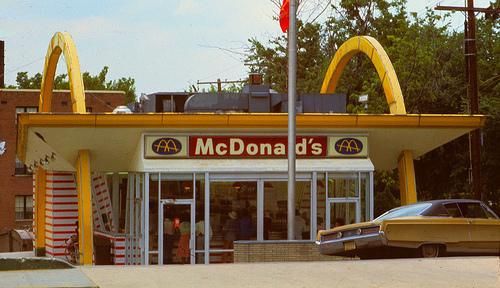
You may recall me mentioning that while McDonald's eventually made it to Adak, it wasn't there during my two years on the island.

In the Mediterranean, one nickname we had for "the States" was "the land of the round doorknob." The European lever-type knobs hadn't made it to the States yet. But both in the Med and on Adak, we also called it "the Land of the Big Mac". Sailors ... okay, American enlisted, period ... always wax nostalgic for whatever they can't acquire locally.


The 1970s ... remember, kids?

The idea of a Big Mac and McDonald's fries was a very appealing daydream to sailors stationed on the wrong side of the planet, where such was not available without making a very long flight, across multiple time zones. We talked about them frequently; you can trust me on this.

An example: in 1974, a shipmate brought back two Big Macs in his suitcase when he returned to Athens. Even 18 hours old, and a little smashed, it was the best thing I'd eaten in weeks. At least I thought so, at the time.


Before inflation...

So in late '75, a rumor began circulating wildly across Adak: some entrepreneurial officers had pooled their resources, requisitioned or chartered a cargo plane, and would fly in with 5,000 Big Macs.

This wasn't just a big deal; it was a BIG. DEAL.

The day the plane landed, there were hundreds and hundreds of sailors and civilians lined up. As soon as the plane taxied to a stop, the line formed almost at the foot of the stairs.

They sold those sandwiches, several hours old at that point, for five bucks apiece ... and sold out very, very quickly.

Me? I only bought five.

What's that?  Why yes, I did eat them all that evening. Didn't want 'em to get stale, don'tcha know.

* * * * *

#4:

The remainder of my free time on Adak was spent enjoying the out-of-doors. Hiking, camping, and occasionally fishing.

And of course, there was the four-wheelin' off-roading which all those dirt roads and jeep trails provided.

Of course, that required a four-wheel drive vehicle. I spent so much time putting chains on that old Galaxy 500, the first winter - and subsequently taking them off, every three days; wash, rinse, repeat - that I was determined my second winter there would be different.

I watched the Adak Eagle's Call (the base newsletter) for ads, and checked the bulletin board at the Navy exchange. Eventually, I saw that a Lieutenant on the Coast Guard cutter had a '67 Bronco for sale. We met, and I drove and bought it.


Solid mechanically; the body was bit the worse for several years of Aleutian weather, and Adak drivers. Still I thought it was the prettiest thing I'd ever seen.  "No more tire chains!"

There were about 12 or 13 miles of actual roads on the developed part of the island. That first weekend after buying the truck, I covered 189 miles ... literally a kid with a new toy.

The truck was a beater, but it had a powerful heater, good brakes and clutch, and the wipers worked. On Adak, those were necessities; anything else was icing on the cake.

I tried to stay on the established roads and paths, but not everyone did.

There were two off-road clubs: the Aleutian CB'ers (remember those?), and the Adak Four-Wheelin' Mud-Slingers.

The Mud-Slingers made a name for themselves - the wrong kind of name - in the fall of '76. They decided to take all dozen or so of their Jeeps, Land Cruisers, and pickups across a wide-open field. Travelling in a line abreast, they sank all 12 vehicles up to the frames in the thick, viscous mud gumbo which underlaid the tundra.

They radioed for help. Public Works sent a road grader to pull them out. It sank, too.

Then a Caterpillar 'dozer, which also became mired. Finally, two 'dozers, the grader, and several volunteers with four-wheel-drives were daisy-chained together, and pulled the Mud-Slingers out. One at a time.

The mess was horrible.

A side-note: tundra doesn't grow back. Well, to be fair, it does ... but very, very slowly. On Adak, there were bomb craters from WWII. The muddy bottoms were still exposed, more than 30 years after the war.

Captain Childers, Commanding Officer, was apoplectic, and issued a new directive. Henceforth, off-road travel was prohibited. We were free to follow any existing trails, but the next person to create a new one would be court-martialed.

Alrighty, then.

* * * * *

#5:

Yesterday, I solicited reader input for any final details, so I'll address a few now.

Q: Did you ever have something that constituted an actual military action or emergency (if such a thing can be told)?

A: I think being strafed by the Russian MiG in the Black Sea came pretty close. While 'Nam was winding down, we in the Mediterranean were in the Cold War. Our destroyers provided off-shore bombardment a few times, and coastal patrols (Yom Kippur War in '73, Cyprus uprising in '74). But the tin cans were primarily tasked with protecting the flat-tops - the carriers - so we chased a lot of submarines, and forced a few to the surface. But the number of times we fired ammo at live targets was pretty limited.

Q: How was your Christian persona received?

A: To be completely honest, I tried hard to run away from God in those years. He never let me get too far away, though, and always pulled me back ... sometimes kicking and yelling. But even at that, those closest to me knew I was a Christian, and I like to think that's responsible for the lasting friendships formed with those shipmates.

Q: How did you come to the pastorate?

A:  I was called to ministry at the age of 12; I still remember that day very clearly. At 18, our local church licensed me as a minister. I had been serving as a lay minister, co-pastor and/or music minister for 15 years when I was ordained in 2000.


That's all there is, folks. I've written now about everything that wasn't classified, so unless I suddenly recall something else ...

Thank you for reading these posts. It's been fun playing "Remember when ..?", and I'm glad you enjoyed it, too.

03 November 2017

Navy Memories #15: Adak Work, Winter, and More

Previous installments:
  1. Boot Camp Memories
  2. About Those Navy Memories
  3. First Orders
  4. Anchor's Aweigh
  5. Man Overboard!
  6. Reflections of a Black Shoe
  7. Destroyer Life and Ports of Call
  8. Warships vs. Big Waves
  9. The Accident, and More Ports of Call
  10. The Black Sea - Operation Silver Fox
  11. 1975, A Year of Change 
  12. North to the Future
  13. Adak Outdoors
  14. Adak Life

Location of Adak Island in the Aleutians
That first long, Aleutian winter dragged on. Heavy snows, strong winds ... digging out the car, putting on chains. Two- and three-foot deep snows were common, hitting every 3 or 4 days.

We were expected to make it to work on time; it's the military, after all, and we weren't excused just because the weather had turned mean. The Security forces drove Dodge Power Wagons with lift kits and large tires, and so did the Executive Officer. If he could make it to work, then it was not a day off.

NOT a Navy truck, but you get the idea.

Personally, I always thought that was a bit unfair. 99 per cent of the sailors on the base drove regular cars or four-by-fours, not lifted trucks. The average personal vehicle didn't have two feet of ground clearance, but that's how it goes.

* * * * *
Williwaw:  2. strong winds which blow from one direction, stop suddenly, and then blow just as strongly from the opposite direction


Foot travel in the winter was difficult. The winds blew almost constantly, and one had to lean sharply into the wind to stay upright.

But williwaws made it tough: you could be walking along, and the wind would stop suddenly. Already leaning forward into that wind, you would start to fall, and then the wind would return from the opposite direction, pushing you onto your face. That was ... unpleasant. And it happened just often enough to be really annoying.

But for driving, there were four levels of "road condition":
  • Delta - normal conditions, roads are clear
  • Charlie - snow-covered, use caution (this was the normal winter condition)
  • Bravo - chains or four-wheel-drive required (travel to/from work or grocery store only)
  • Alpha - roads are closed; do NOT attempt to drive
In winter time, these conditions were announced on the radio every morning. We all prayed for Road Condition Alpha, of course, but it rarely happened. I only recall Alpha occurring once in the two years I was there.
* * * * *
In my previous post, I wrote about volunteer work at the radio and TV stations. But most weekends were spent driving around, or camping and hiking, depending on the weather.

Driving on Adak could be challenging. In winter, you had to use four-wheel-drive just to get out of the parking lot, as it was rarely plowed. The on-base roads were kept as clear as possible, but sailors who parked at the barracks were on their own. I kept a snow shovel and a broom in my truck, just for digging out.

But driving off-base was always an adventure.

For that matter, walking off-base wasn't for the faint of heart, either. More than once I set off with backpack, only to have snow move in and go from flurries to mid-thigh deep in 15 or 20 minutes. That was a "go back to the barracks and try another day" moment.


I asked a Navy buddy from Adak if he remembered anything about that sort of thing, and this was his reply:
I remember that you and I backpacked to the cabin late one winter's evening. The snow was deep and the night was really dark and cold. About 15°, if I remember correctly. When  we arrived at the cabin, we found that the door had been kicked open, and the drift was piled as high as the door. We climbed over and then slid down the opening into the cabin.  
By that time you were chilled, so you immediately rolled out your goose down mummy bag on a foam pad, and climbed inside to get warm. I had a borrowed sleeping bag, and did the same. I didn't get much sleep that night, in a summer bag on the wooden floor. You slept soundly in the goose down. 
Craig P.

I don't remember now why we didn't light a fire (it's been 41 years, so forgive me) but it's safe to say that any scrap lumber in the area would have been under a few feet of snow by that point, and hard to find at the very least.

I had a small tent in my pack, but couldn't set it up on the wood floor. This was long before tents came with fiberglass poles, and needed pegs and guy-wires to stay up.  Just the same, I wish I'd known Craig was that cold. We could have pulled up a section of flooring to burn for heat; wouldn't have bothered me a bit.

* * * * *

Adak was such a starkly beautiful place. The mountains, streams, lakes, the ocean ... just so gosh-darn photogenic!


Adak had a number of places which were off-limits (i.e., secret / top secret / or otherwise "authorized personnel only"). Some of those were guarded by the Marines. If you didn't have a pass, or your name didn't appear on that day's list of authorized visitors, you weren't getting in - and shouldn't try.

At one point in the spring of '76, COMNAVPACFLT came to visit. That's "Commander, U.S. Navy Pacific Fleet" to you landlubbers ... and that's A Big Deal to the sailors and Marines on the island. When the Commander of the Fleet shows up, you snap to like you've never snapped before!

The Commanding Officer of the Naval Station was showing the Admiral around the base, and they pulled up to one of those barbed-wire-and-armed-guard gates. The C.O. was always authorized to visit, so that wasn't a problem. But said Admiral's name did not appear on that day's list.

Without any further ado, the CO and the visiting Admiral found themselves face down in the snow, while the Marines sought identification and possible clearance for the unexpected guest.

Word of that event spread quickly around the base (and the Navy rumor mill makes office gossip seem like a snail's pace, in comparison). Sailors, in general, were aghast that the C.O.'s boss's boss was arrested and detained by the Marines.

Heads were gonna roll; we were sure of it.

Except that the Commandant of the Marine Barracks received a letter from the Admiral, commending him for how well the guards did their job. He wasn't on the list, and he knew it. It was a test, you see. If the guard(s) had allowed him in, no matter their reason, there'd have been disciplinary hell to pay.
But the guards did their job in exemplary fashion.

And the rumor mill had fresh grist for a week. :)